
Letters toParadise
A story by RayHope
Letters to Paradise
Opening the book
A story by RayHope
Letters to Paradise
A story by RayHope
Part One
Every search for the stars
begins with a question,
and every universe hides a mystery
waiting to be found.
RayHope
Before the first page
Part One
Letters to Paradise
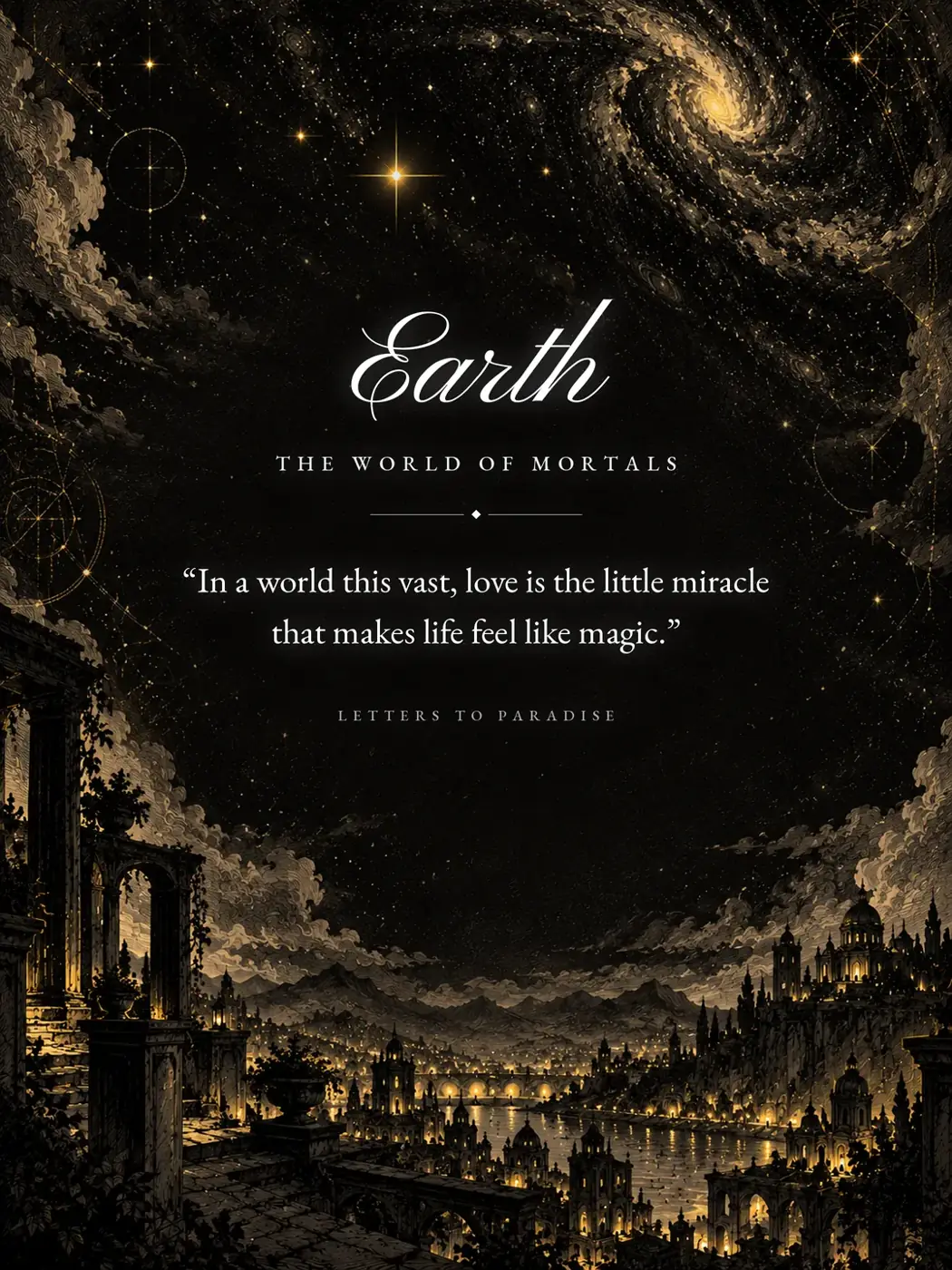
Earth · The World of Mortals
The picnic blanket had slipped halfway down the gentle slope beside the lake. Ray Ezhil sat on its edge, eight years old and full of questions, while his father crouched over a battered telescope as if it were a patient in need of delicate surgery.
“Hold this part steady, Ray.” His father, a professor of quantum physics, tightened a small screw and tested the telescope’s movement. “If you keep shaking it, even the Moon will look as if it’s running away from us.”
Ray caught the tube with both hands. “Maybe it is running away.”
His mother laughed from the blanket. She was a neurologist, a doctor and researcher whose work often took her into the mysteries of the human brain. Both his parents held doctorates, and both had taught him that curiosity was not a nuisance. It was a door. They spent their days studying questions that seemed too large for ordinary life: space, matter, consciousness, and the universe itself. At home, those subjects became stories told to a little boy who never ran out of why.
They had eaten lunch beside the lake. The afternoon was moving towards evening, and the first stars had begun to emerge in the fading blue. His father finally handed the telescope back to him. “There. Not perfect, but it should work.”
Ray looked through it, then lowered his eye. “Dad, what’s above the clouds?”
“The sky, then space.”
“And above space?”
His father smiled. “Space is not a ceiling with another room above it. It stretches farther than we can easily imagine. The stars you see are suns, some much farther away than our minds can comfortably picture.”
“And all the stars together are our universe?”
“They are part of it. Galaxies, stars, planets, dust, light, everything we can observe belongs to the universe we know.”
Ray considered this with solemn concentration. “And after our universe?”
His father’s smile softened. “We don’t know. Some theories allow for other universes. We have ideas, mathematics, clues. But we don’t have a confirmed way to visit one.”
“Would people live there? People like us?”
“It’s possible,” his mother said. “But possible isn’t the same as proven. We have to be honest about what we know and what we’re still trying to understand.”
Ray turned to her. “If there are people there, could they build a gate to come here? Like a door between two houses?”
“Perhaps one day,” his father answered. “If the laws of nature allow it, someone might discover a way to connect places that seem impossible to reach today.”
Ray looked back through the telescope. “Then there could be a universe where God lives.”
Neither parent laughed. His mother moved closer and brushed a strand of hair from his forehead. “People have wondered about that for thousands of years. Science can investigate the universe. Faith and philosophy ask other kinds of questions. We shouldn’t pretend we have proof when we don’t.”
“But if God is there, why doesn’t he come here?” Ray asked. “If he can do everything, why doesn’t he come down and help people? Why does he make people sad? Why doesn’t he just show us he’s real?”
The questions came faster after that. Would God have a body? Would he look like a person? Would there be stars in his universe? If someone opened a gate, could they meet him? If another universe had its own people, would they know about Earth? Would they speak the same language? Would they have their own stories about gods?
His father listened to every question as if it deserved the same attention as a question asked in a lecture hall. “You may spend your whole life looking for answers,” he said. “Some answers will come. Others may stay beyond your reach. The important thing is to keep asking without deciding what the answer must be before you find it.”
His mother took his hand. “And remember something else, Ray. A mystery doesn’t become less beautiful just because we don’t understand it yet.”
They told him that people had searched for the divine in the stars, in nature, in mathematics, in silence, and in one another. They told him that not knowing was not a failure. It was the beginning of honest searching.
Ray leaned against her shoulder. For a while, he was content to watch the first stars emerge. But even then, somewhere inside him, a door had opened. He wanted to know what waited on the other side of everything.
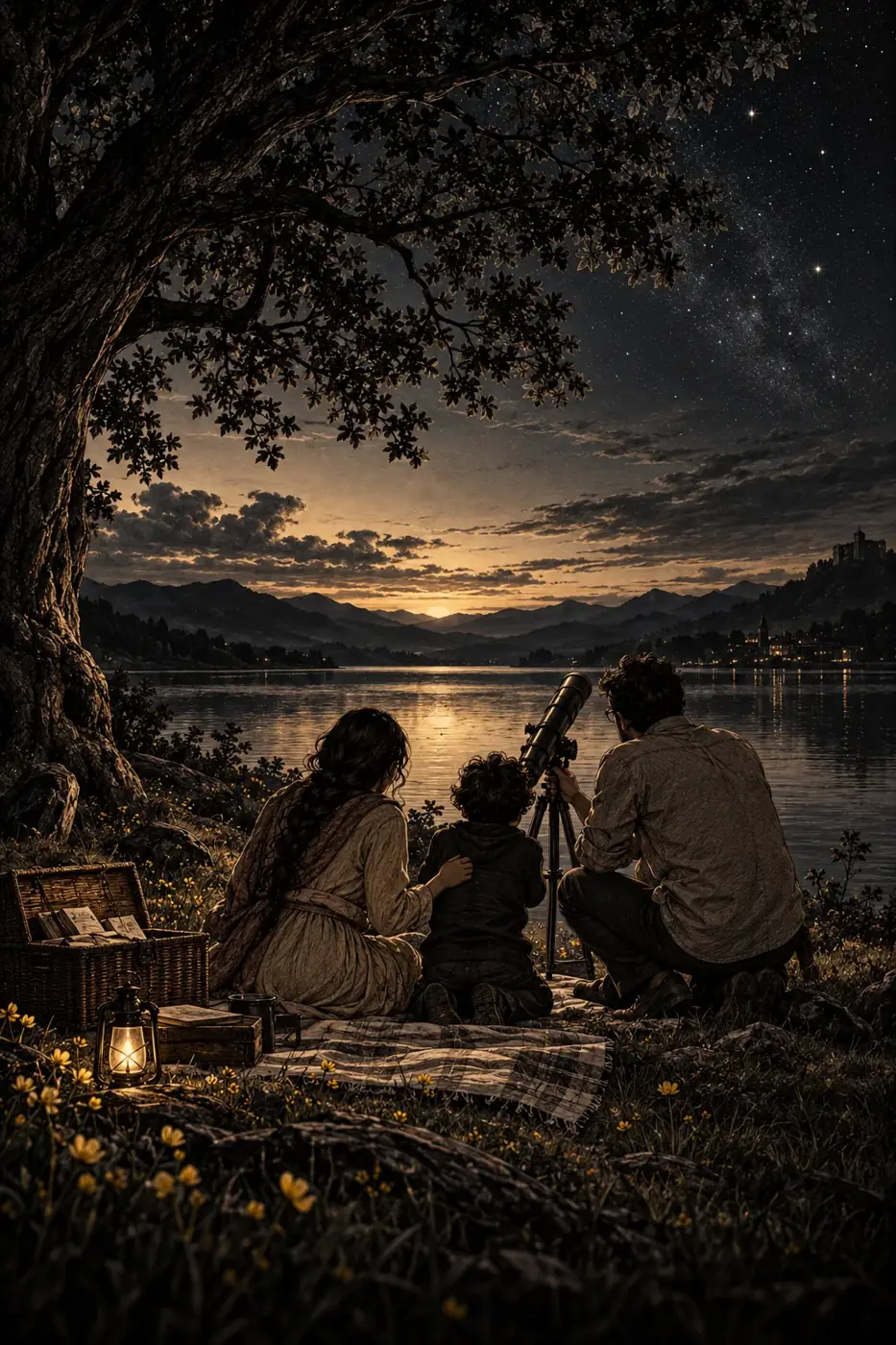
When the stars had gathered over the lake, Ray sat cross-legged on the blanket, drawing a crooked circle in the dust with a twig. Inside it he drew a smaller circle, then another, until the whole thing looked like a nest of rings.
“What is that?” Mom asked.
“The universe.”
“Which circle is us?”
Ray pointed to the smallest one. “This one. But maybe it only looks small because we’re standing inside it.”
His dad paused while folding the picnic cloth. “That is a very good way to think about perspective.”
Ray added another circle around the others. “And maybe there’s another universe outside this one. And another outside that.”
“Maybe,” Dad said.
“Do you think we’ll ever know?”
His dad looked out over the water. “I think we will learn more than we can imagine. I also think every answer will show us another question.”
Ray seemed delighted by that. To him, a new question was not a burden. It was a road that had not yet been built.
Mom sat beside him and brushed a leaf from his hair. “You don’t have to solve the universe today, Ray.”
“I know.” He looked up at her. “But can I start?”
She kissed his forehead. “You already have.”
He did not know how much of that afternoon he would carry into adulthood: the warmth of the blanket, the click of the repaired telescope, his father’s calm voice, his mother’s hand in his hair. Memory would preserve the smallest things with cruel precision. Years later, he would remember the shape of the sunlight on her wrist more clearly than the words spoken in the hospital.
For now, he was eight years old, and the universe was still a place where his parents could answer questions.
On the drive home, Ray sat in the back seat with the old telescope resting beside him. At a traffic signal, he leaned forward between the front seats. “Mom, can we get ice cream?”
“We’ll see,” his father said. “Let’s cross this signal first.”
“You said that before.”
“And I meant it before.”
Ray continued negotiating with the persistence of a child who believed every problem could be solved if he explained it one more time. His mother was halfway through answering him when a bright streak crossed the darkening sky beyond the car window.
“Mom! Look! Did you see that?”
She turned towards the window. The streak vanished almost as soon as it appeared, leaving the sky unchanged. “I saw it. It may have been a meteor, a small piece of space rock burning as it entered the atmosphere.”
“A fallen star,” Ray whispered.
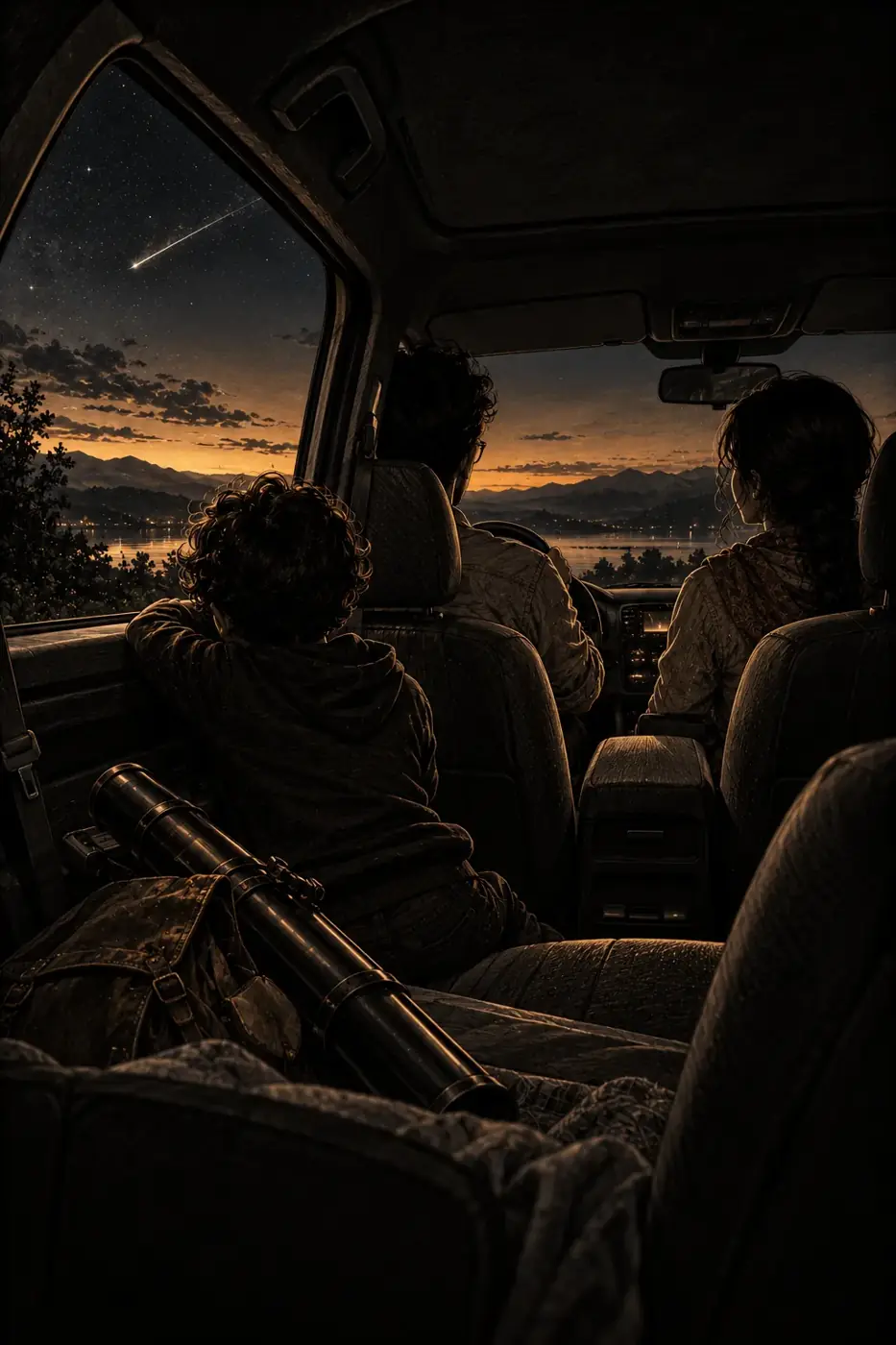
“That’s what people call it,” she said gently. “It isn’t really a star falling from the sky.”
He was still looking up when the world broke apart.
A horn blared. Headlights filled the window. A heavy truck struck their car with a force that erased every other sound. Metal screamed. Glass burst into the air. The telescope flew from the seat. Ray felt the world turn, then darkness swallowed everything.
When he opened his eyes again, the light above him was white and merciless. His body felt distant, as though it belonged to someone else. Pain came in waves. His throat was dry. He tried to move and couldn’t understand why his limbs would not answer him.
“Mom?”
No answer.
“Dad?”
A nurse came to his bedside and spoke softly. She tried to comfort him, but he kept searching the room. He asked the same questions until exhaustion pulled him back into sleep.
The next day, he woke with the same terrible emptiness. A doctor sat beside him, choosing each word carefully. His parents had not survived the accident.
Ray stared at him. The sentence entered the room, but it did not enter his mind. His parents had been there yesterday. His father had fixed the telescope. His mother had explained the falling star. They had promised ice cream. They could not simply stop existing between one breath and the next.
He cried until he had no strength left. Then he cried again when he woke. For days, he called for them. He refused food, refused sleep, and turned towards every footstep in the corridor, hoping it would be one of theirs.
Grief did not arrive as one clean wound. It came as a thousand small discoveries: an empty chair, a voice that sounded almost like his father’s, the smell of a familiar soap on someone else’s hands. Every ordinary thing became proof that the world had continued without asking his permission.
When the doctors began explaining the injuries he had suffered, Ray was too tired to understand them. They spoke to him gently, then repeated the explanation when he was stronger. The accident had damaged his body. Walking would not come easily again. He would need rehabilitation, physiotherapy, and support. A wheelchair or mobility aids could help him move safely while he learned what his body could manage.
Ray looked down at his legs as if they had betrayed him. “Fix them.”
The doctor did not look away. “We’ll work with you. We’ll help you get as much strength and independence as possible. But I need you to understand that recovery may not mean returning to exactly how things were.”
“Then you’re not fixing them.”
Rehabilitation began with small movements that felt humiliatingly large. A hand gripping a rail. A foot finding the floor. A breath held while a therapist counted. The supports that helped Ray stand seemed to announce his injury before he could speak.
He hated them. He hated the careful voices, the encouraging smiles, and the way adults said brave when they meant broken but still moving.
He pushed away the exercises, snapped at the therapists, and refused to practise the movements they showed him. Every instruction sounded like a verdict on the person he had been before the accident. He had lost his parents. Now strangers were telling him that even his own body would never be quite the same.
One afternoon, the doctor returned alone. He pulled a chair beside Ray’s bed and waited until the boy stopped pretending not to see him.
“You think I’m telling you that your life is over,” the doctor said. “I’m not. I’m telling you that your life has changed, and we have to learn how to live inside that change.”
Ray’s eyes filled. “I can’t even walk like before. I can’t bring my parents back. What can I change?”
The doctor let the silence remain for a moment. “You’re measuring your whole future against what you lost. I understand why. But you are still here, Ray. You can learn. You can build things. You can make a life that belongs to you. Don’t call yourself less than other people because you need support. And don’t call yourself special just because someone says it. Build the person you want to become, one day at a time.”
Ray swallowed hard. “If God exists, maybe he can see me.”
“Maybe,” the doctor said. “I can’t give you proof of God. But I can tell you this: if you want answers about the universe, you’ll need to study it. Learn the mathematics. Learn the science. Learn how to question your own assumptions. If you want to reach a mystery, you have to become capable of reaching for it.”
Ray’s face changed. It was not peace. It was something smaller, harder, and more durable: a decision beginning to form.
“Then I’ll find the universe where God is,” he said. “I’ll open a gate. And if I find him, I’ll ask why he let this happen. And if my parents are somewhere beyond here, I’ll find them too.”
The doctor did not promise him that he could. He only rested a hand on the bedrail. “Then start by getting through today.”

When Ray was finally allowed to return home, the house seemed to have forgotten how to be a house. His parents’ books remained on their shelves. A cup still stood beside his father’s desk. His mother’s scarf hung over the back of a chair. Nothing had moved, and yet everything was wrong.
The first invention he made after the accident was not a machine that could change the world. It was a simple arrangement of straps, hooks, and a small wheeled tray that allowed him to carry books from his bed to the desk without asking someone to do it for him. The first version collapsed. The second dragged sideways. The third worked well enough to hold two books and a glass of water.
He did not celebrate. He only adjusted the screws and tried again.
A caregiver found him working late one evening and asked why he would not let someone help.
“Because I want to know how it works,” he said.
“You could ask someone to bring you the books.”
“I could.”
“But you’re not going to.”
Ray shook his head. The answer was not pride alone. He had lost control of too many things in one afternoon. He wanted to reclaim the small ones.
He began to learn that independence did not mean never needing help. It meant being allowed to decide what kind of help he needed, and when. He would take years to understand that distinction. For a long time, he treated every offered hand as a reminder of what had been taken from him.
The doctor who had sat beside his hospital bed continued to visit. He never told Ray that determination would heal every injury. He told him something more useful: progress was not a straight line, and a bad day did not erase a good one.
Ray wrote that sentence on a scrap of paper and pinned it above his desk. He did not believe it every day. He kept it there anyway.
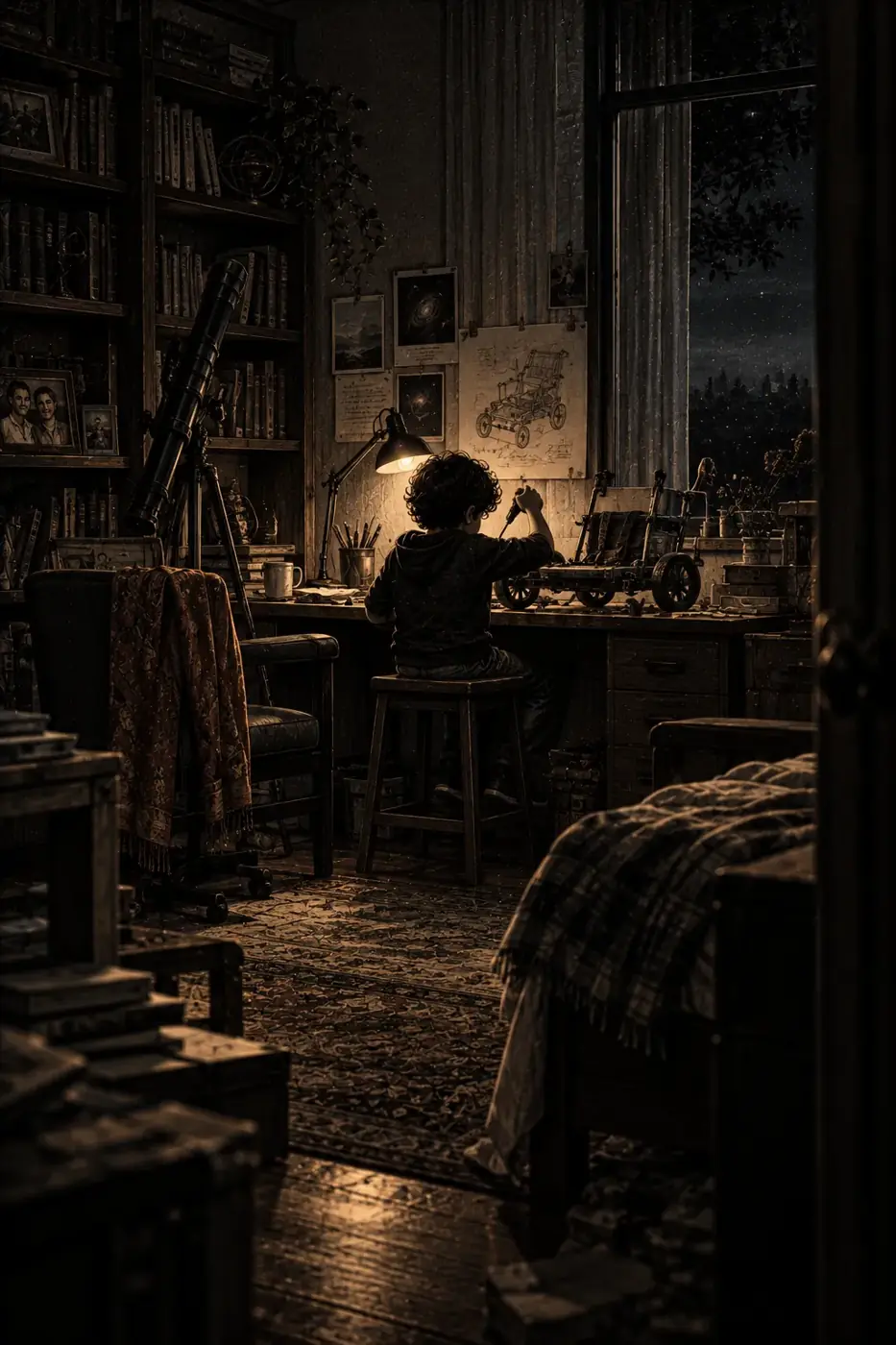
The years did not heal Ray in a straight line. He learned to use the support his body needed. Some days he hated every step of the process; some days he surprised himself. He became fiercely independent, not because he never needed help, but because he wanted the freedom to decide what kind of help he would accept.
He studied with an intensity that unsettled his teachers. When classmates went out, Ray stayed with textbooks, papers, and experiments. He learned physics, mathematics, programming, and the developing science of artificial intelligence. His childhood questions became notes in the margins of his notebooks. The notes became diagrams. The diagrams became projects.
He built small tools to make daily life easier: a compact AI search system that could organise research, a drone that could retrieve objects he could not easily reach, and little devices that made his world more manageable. He called the drone Pip, short for “Pick It, Please.” Pip had no spoken voice. It communicated through a small screen, showing messages, icons, and the occasional expression that Ray programmed into it when he needed a laugh.
Pip became more than a convenience. It was a quiet companion in a home where no one else knew how to live with Ray’s silences. Sometimes it fetched a book. Sometimes it brought him a tool. Sometimes it displayed a deliberately unimpressed face when he forgot to eat.
Ray kept learning. At college, he wrote papers on quantum systems, universe models, and possible ways of detecting or communicating across realities. He did not claim to have solved the impossible. He only kept testing the boundaries of what others had dismissed too quickly.
Yet the boy beside the lake never entirely disappeared. When a star appeared in the night sky, Ray still thought of his mother explaining the meteor. When he repaired a piece of equipment, he heard his father telling him to hold it steady. He rarely spoke about them. He had learned that grief could be private without becoming small.
By twenty-nine, Ray had become a brilliant, unusual young researcher with a reputation for seeing problems before other people noticed them. He could be abrupt, awkward, and so absorbed in a technical question that he forgot the room around him. Emotion was not absent from him; it was simply locked behind years of discipline, loss, and fear. He had learned how to solve systems more easily than he had learned how to let another person close.
Then, one ordinary morning, an email arrived that changed the direction of his life.
The invitation came from Project Omnia, a research initiative whose public description was brief enough to reveal almost nothing. The message referenced Ray’s published work and invited him to an interview at a secure research facility. Several documents were attached, but their explanations were carefully limited. Much of the project, the email warned, could not be shared outside authorised channels.
Ray read the invitation twice. Then he opened the documents, marked the gaps, and started searching for the questions they had not answered.
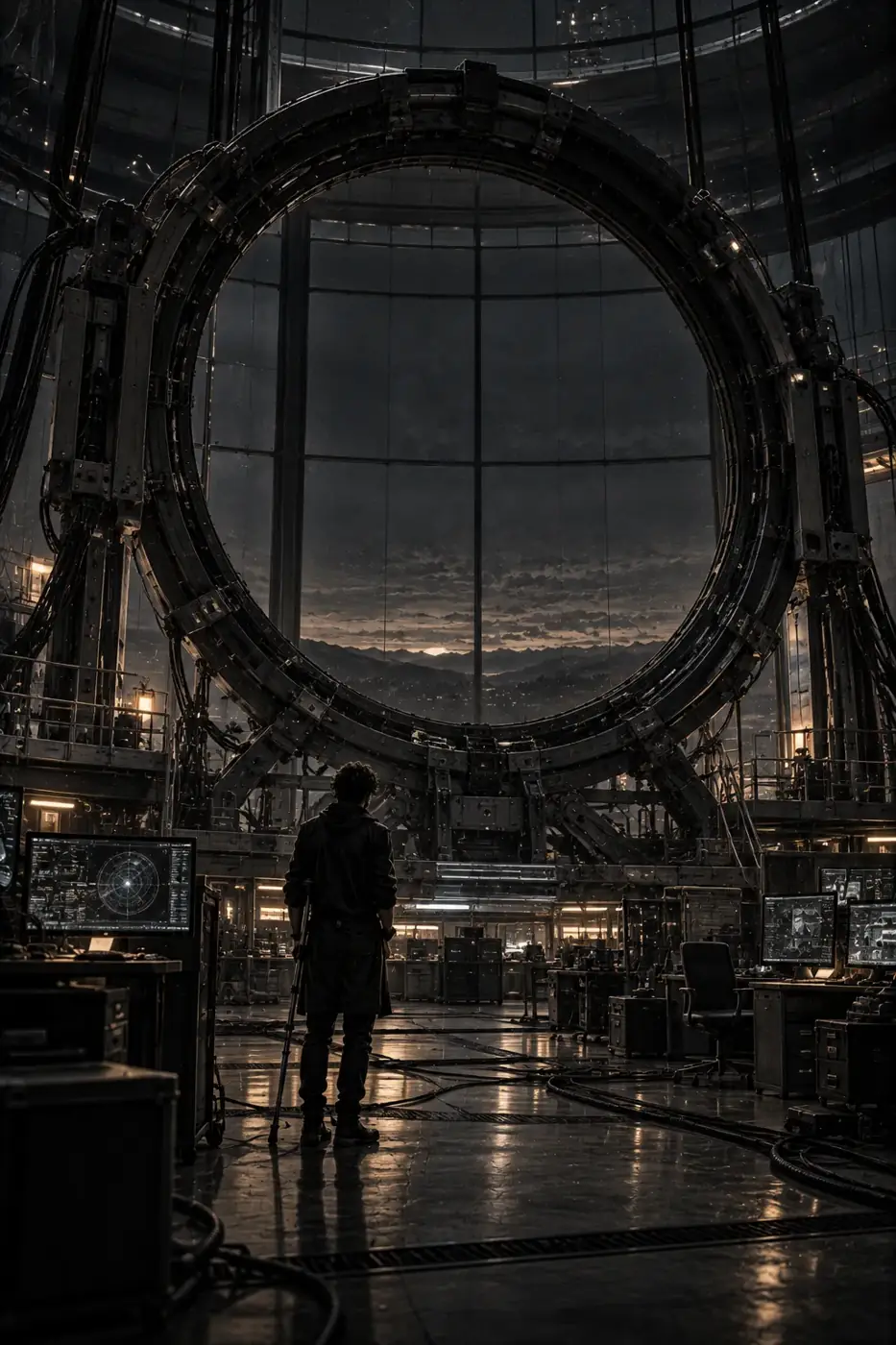
The facility was larger than he had imagined. Its corridors were clean and quiet, its doors controlled by layers of security. Behind the glass of the main laboratory stood a machine that made every diagram he had drawn as a child seem embarrassingly small. It was not merely a portal in the shape of a door. It was a complex system of linked equipment, sensor arrays, a stabilised field structure, and a neural interface designed to connect a human mind to a signal originating beyond the known universe.
Project Omnia was a collaborative effort. Physicists, neuroscientists, engineers, and specialists from several fields were working together to investigate what might exist beyond the universe they could observe. The Omnia Gate was intended to establish a connection with other realities and, through a controlled neural link, allow a person to attempt communication with an entity on the other side.
The first explanation left Ray silent. For once, he had no immediate correction to offer. He moved closer to the observation glass, staring at the gate with an expression so unguarded that the project director glanced at him twice.
The interview room had one glass wall overlooking the main laboratory. Ray could see the Gate beyond it, its circular frame held in a cradle of metal supports. It looked less like a doorway than a question someone had built out of steel.
The director asked him why he wanted to join Project Omnia.
Ray had prepared an answer about research, interdisciplinary collaboration, and the value of testing speculative models with measurable experiments. All of it was true. None of it was the whole truth.
“I want to understand whether the universe we can observe is the only reality available to us,” he said. “And whether the mind can make contact with something beyond it.”
“Why does that matter to you personally?”
The question landed too close. Ray looked through the glass at the Gate. “Because I think there are questions worth spending a life on, even if the answer is no.”
The director studied him. “That is not quite an answer.”
“It’s the most honest one I can give you.”
“You understand what we’re attempting?” the director asked.
“I understand the goal,” Ray replied. “I don’t yet understand why your signal filter discards part of the data before the system has classified it. You may be removing noise, or you may be removing the only useful pattern in the entire sample.”
The room quieted. The project director, Dr. Adrian Cole, turned towards the display. Around the table were the people who had spent years bringing the Omnia Gate this far: Dr. Ingrid Vogel, the quantum physicist who trusted no pattern until it survived a dozen tests; Theo Bennett, the systems engineer who believed almost any problem could be solved with a patch; Liam Brooks, the robotics and instrumentation engineer who named equipment as if it were a collection of pets; and Dr. Elena Weiss, the lead neuroscientist responsible for ensuring that the human brain could survive the connection. Ray asked to see the raw output, the calibration history, and the filtering sequence. The director hesitated, then authorised a supervised review.
Within minutes, Ray had identified several inefficiencies. He did not pretend to know every answer. He asked pointed questions, ran comparisons, and explained where the system was losing information. He suggested alternative processing methods, a more selective approach to signal filtering, and a nano-gold layer that might make the particle interface more stable. His excitement was almost childlike, but his reasoning was precise.
“This is not a toy,” one senior researcher said, half warning and half admiration.
“I know,” Ray answered, still staring at the data. “That’s why I want to fix it before we mistake a limitation in our machine for a limitation in the universe.”
The interview became a technical session. The team had expected a candidate who could discuss his papers. Instead, they found a researcher who could connect their published principles to the machine in front of him and quickly identify places where the design could improve. A few team members were unsettled by how quickly he worked. Others were delighted. Even those who felt a flicker of jealousy could not deny the value of what he was doing.
By the end of the day, Ray had been offered a place on the team and an unusually broad level of access under the project’s security rules. He accepted before anyone could finish the final sentence.
When the meeting ended, the director walked him to the glass wall.
“This project has been built by many people,” he said. “No single mind owns it. If you join us, you will be expected to challenge us, and to accept being challenged in return.”
Ray nodded. “That’s what I want.”
He did not say that, for the first time since the accident, he felt he might be walking toward something instead of merely away from grief.
That evening, he returned to the laboratory and worked long after the others had expected him to leave. He was no longer looking at the Omnia Gate as a researcher examining an unfamiliar system. He was looking at it as the boy who had once stared through a repaired telescope and asked what waited beyond everything.
The following morning, Ray arrived with Pip.
The director looked at the little drone, then at Ray. “What is that?”
“Pip. My assistant.”
“You brought an unauthorised device into a restricted facility?”
“I brought a device that can save me time. Your team is excellent, but I can’t work at the speed I need if I have to keep stopping to fetch things.”
“That is not how authorisation works.”
Pip’s screen lit up: TEMPORARY VISITOR. PERMANENT CONTRIBUTOR.
A startled laugh escaped one of the researchers. Someone else covered a smile. Ray looked at Pip as if it had committed a minor professional offence.
“It is not a permanent contributor,” the director said.
Pip changed its display: UNDER REVIEW.
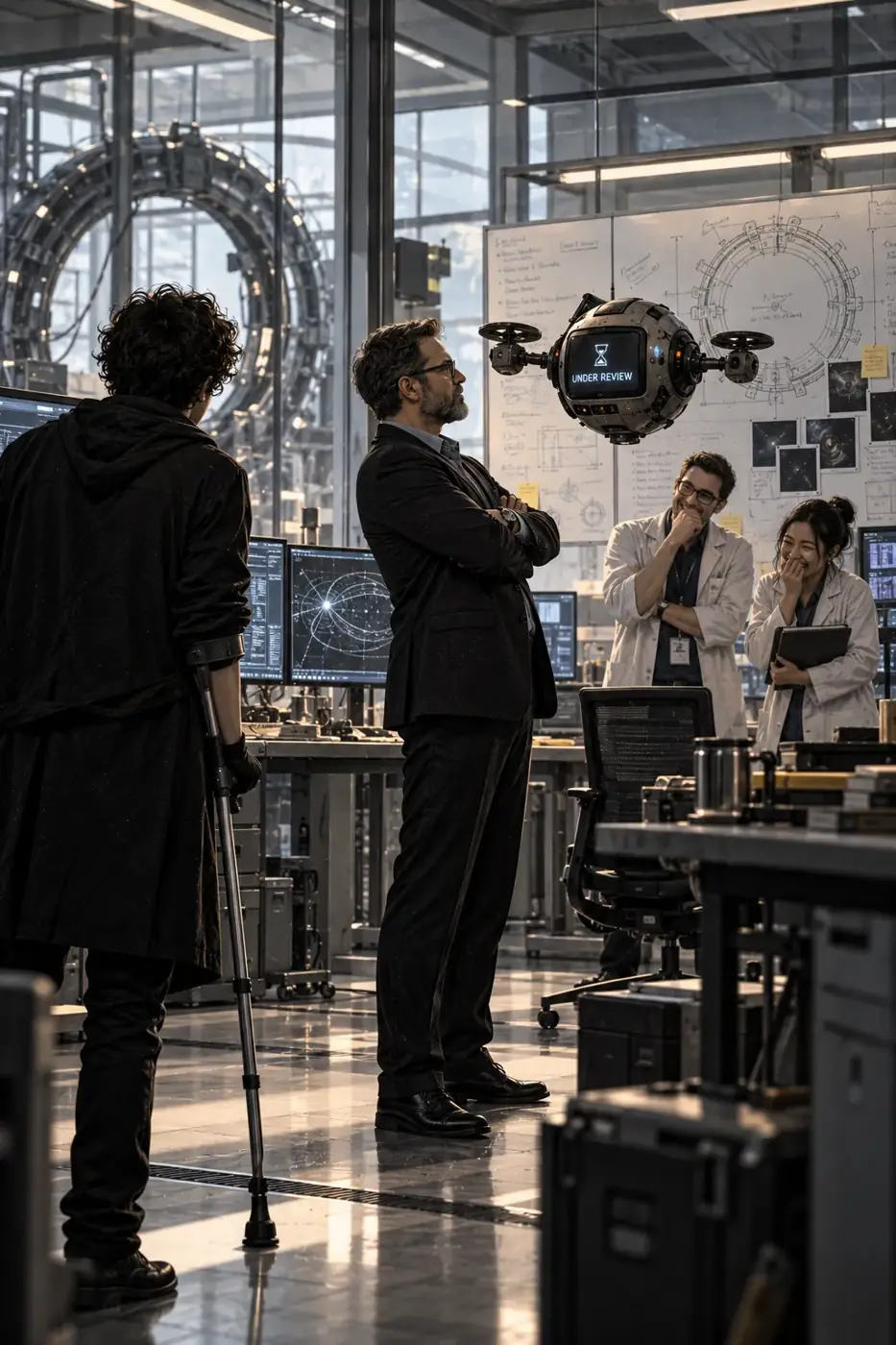
The room broke into laughter, and even the director’s stern expression softened. Ray explained Pip’s functions and agreed to a security inspection. Once the team confirmed that the device could be safely restricted to approved systems, they granted it temporary access for the work Ray was doing. He promptly requested that the arrangement be made permanent.
“You have been here for less than two days,” the director reminded him.
“And I’ve already saved you time.”
“You have also tested my patience.”
“That’s a separate metric.”
Pip displayed a small celebratory animation. The director shook his head, but the approval came through. Pip was allowed to remain under the team’s conditions, and Ray returned to work as if the entire exchange had been a minor systems check.
By lunch, Liam had already tried to inspect Pip’s tool compartment twice. Pip had refused both times, displaying a neat little message: ACCESS DENIED.
“I work in robotics,” Liam protested. “I’m professionally qualified to be curious.”
Pip changed the message to: CURIOSITY IS NOT AUTHORISATION.
Theo nearly choked on his coffee. “It’s been here one day and already understands our security policy better than Liam.”
“I understand the policy,” Liam said. “I object to being judged by a device that can’t even drink coffee.”
Pip’s screen displayed a coffee-cup icon, followed by INEFFICIENT FUEL SOURCE.
Dr. Cole walked past without slowing. “I agree with the drone.”
Ray glanced up from his work. “Pip has excellent judgment.”
“You built it,” Ingrid said. “You’re hardly an independent source.”
“I built it to disagree with me when the data supports disagreement.”
Pip displayed: RARE EVENT.
For the first time, Ingrid laughed at one of Ray’s answers rather than one of his calculations.
For the first time in his life, Ray was standing inside a machine built around the question that had shaped him since childhood. He was close enough to touch the gate’s outer frame. He was close enough to imagine the other side answering back.
The project advanced in measured stages. Ray’s proposed changes improved the way the system handled the incoming signal. When the experimental nano-gold particles arrived, the team incorporated them into a revised configuration intended to improve stability and resolution. The work required careful calibration, repeated checks, and a level of patience Ray rarely found comfortable. But each successful test brought the machine closer to the goal.
Once the nano-gold interface was in place, the readings became cleaner. A signal that had once appeared and vanished in fragments began to hold its shape. The Gate still did not provide a neat window into another world. It gave them traces, rhythms, and fleeting impressions that could be measured but not yet understood.
Ray stood in front of the display, scarcely breathing. He remembered the picnic blanket, the telescope, his father’s hand on his shoulder. He remembered asking whether someone out there might be looking back.
The team celebrated the technical improvement, but Ray felt something quieter and more frightening: the childhood question had survived every year of grief, and now it was answering him, not with certainty, but with possibility.
The Gate could not yet choose a destination with confidence. It drifted among patterns that seemed to belong to different realities. Ray began designing filters that would let the team narrow a connection, one signature at a time.
It was the first step toward steering the search. It was also the first step toward a danger none of them yet understood.
The celebration lasted exactly four minutes before Ingrid asked for another control run. Theo called this “the shortest party in scientific history.”
“Four minutes is generous,” Elena said. “The coffee machine had a longer celebration when it was repaired.”
“That machine has never produced coffee on time,” Liam said. “It has only produced suspense.”
Pip drifted over to the counter and displayed: BEVERAGE QUALITY: UNRELIABLE.
Ray looked at the screen. “You don’t even drink coffee.”
I OBSERVE.
“Of course you do,” Ray said. “You observe everything.”
Pip displayed: SOMEONE HAS TO.
Dr. Cole pointed towards the Gate. “Let us observe the thing we are paid to observe.”
They returned to work, still smiling, until the new signal appeared.
The first signal that made the room go silent was almost disappointingly small. It appeared as a faint pulse on a display, repeated at uneven intervals. It might have been noise. It might have been a flaw in the equipment. It might have been the sort of pattern that human beings found meaningful because they wanted meaning to be there.
The team tested it again.
“Nobody celebrate yet,” Ingrid said, already pulling the readings onto a second screen. “It could still be interference.”
Theo raised his mug. “I wasn’t celebrating. This is my normal expression when I’m holding coffee.”
“That is not your normal expression,” Liam said. “Your normal expression is when you’ve broken something and are waiting to see whether anyone noticed.”
“I prefer the term ‘testing the limits of the system.’”
Elena Weiss did not look up from the medical telemetry. “Please test the limits of the coffee machine instead. It has no nervous system to damage.”
Dr. Cole folded his arms. “Repeat the sequence.”
They did. The pulse returned, and the jokes faded as the team watched the same small pattern emerge again.
They changed the calibration. They replaced a component. They ran the sequence under different conditions and asked another team to review the data without telling them what to expect. The result was not a voice, not a face, not a proof of another world. It was a pattern that resisted easy dismissal.
Ray stood beside the display with his arms folded, every part of him trying not to hope too much.
“Could it be another universe?” one researcher asked.
“It could be a signal we don’t understand,” the director replied. “Those are not the same statement.”
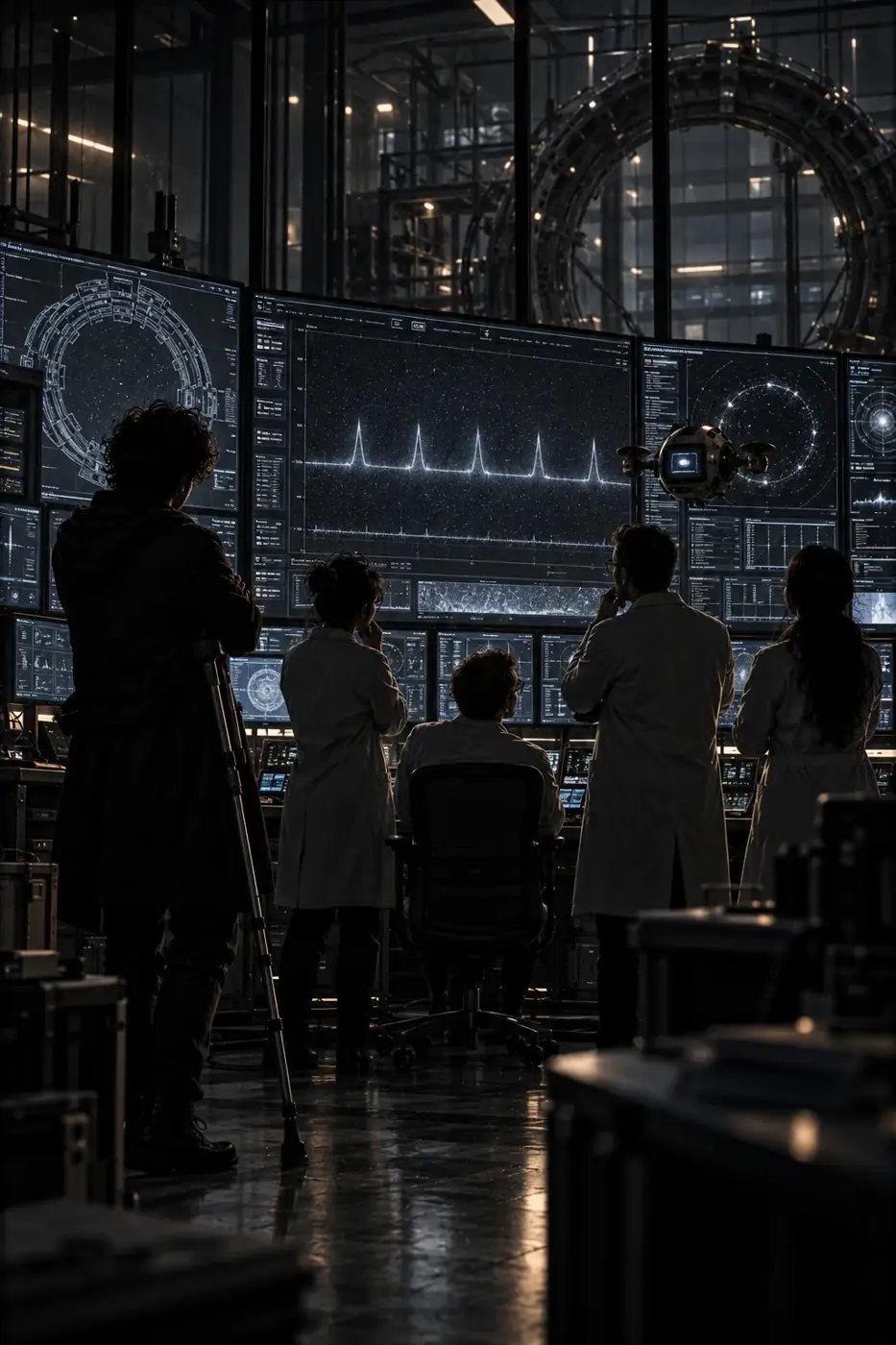
Ray appreciated the caution. He also felt the old question rising inside him like a second heartbeat. What if someone was there? What if the stars were not a wall, but a shoreline?
He went back to the filter design and worked until the lab lights shifted into their night setting. Pip found him there, displayed a tiny picture of a sandwich, and then showed a clock with its hands pointing toward an unreasonable hour.
“I’m not hungry,” Ray said.
Pip changed the sandwich into a skull and crossbones.
“That’s dramatic.”
The drone displayed: EAT.
Ray sighed and accepted the sandwich Pip had retrieved. “You are the only assistant I know who can threaten me with lunch.”
Pip showed a triumphant check mark. Then it turned back to the display, its little camera facing the strange pulse.
For once, even Pip seemed to understand that the room had become a place where something impossible might begin.
For the first time, the team could begin narrowing the connection rather than allowing each attempt to drift towards a different possible reality. The Gate’s targeting system was still experimental, but the patterns were becoming more consistent. Ray watched the results with a smile he could not quite suppress.
“We can choose the signal profile we want to pursue,” he told the team. “Not perfectly, not without uncertainty. But we’re no longer throwing a question into the dark and accepting whatever answers first.”
The room filled with cautious excitement. A short human test was approved under controlled conditions. The volunteer remained connected only briefly while the team monitored the interface and recorded the results. The signal was clearer than expected. The neural link appeared to carry structured patterns from the selected reality, and the system returned with data that looked far more coherent than anything they had seen before.
Ray studied the graphs, checked the raw records, and ran the calculations again. The results held. He was so relieved that, for a moment, he forgot to hide his feelings. He laughed under his breath, then covered his mouth as if he had revealed something private.
“That’s it,” he whispered. “We can finally aim.”
Theo spun his chair towards the others. “I would like the record to show that I predicted this would work.”
“You predicted it would work after Ray changed the filter,” Ingrid said.
“I predicted that someone would change the filter.”
“That is not a prediction. That is a description of this laboratory.”
Liam pointed at Pip. “Can we get the drone to certify the result? It seems to be the only one here whose opinions are always recorded.”
Pip displayed: RESULT REQUIRES INDEPENDENT VERIFICATION.
Elena nodded. “For once, I agree with the drone.”
Ray looked at Pip. “You’re enjoying this.”
The screen showed a small smiling face.
“I knew it,” Ray muttered.
But not every question had been solved. A connection could be established, yet the team still had to understand the people or beings on the other side. A person might arrive in a reality whose language they did not speak, whose customs they could not recognise, or whose religious and cultural assumptions were entirely different. They might mistake a greeting for a threat. They might not understand where they were or how to return. Even a successful connection could become a trap if the visitor could not communicate.
The project director convened a meeting to discuss the missing expertise. The team needed someone who could interpret mythological systems, ancient symbols, religious traditions, and cultural histories, not to prove that any mythology was true, but to help the researchers understand the worlds they were attempting to reach.
A name appeared in the candidate material: Nila Metilda.
She was twenty-eight, a professor and scholar whose published papers examined comparative mythology, ancient civilisations, and historical texts. Her work was careful and wide-ranging. She had a deep interest in stories about gods, divine realms, fallen beings, and the possibility that old myths might preserve humanity’s attempts to describe experiences it could not explain. She also carried a private dream of becoming a singer and an actor, a passion she had never entirely allowed herself to pursue.
Ray had never met her. He barely noticed the name before the director moved to the next item on the agenda.
Nila, meanwhile, received an invitation that offered little more than a confidential interview and a request to discuss her research. She arrived expecting an academic consultation. She did not expect to be led into a secure laboratory and shown a machine that might connect a human mind to another universe.
During the interview, the team asked her to explain several symbols and the cultural contexts in which they appeared. Nila answered with calm precision. She distinguished between what a text actually said, what later traditions had added, and what modern readers tended to assume. When the panel asked whether an old account of a divine gate could be treated as a literal technical description, she refused the easy answer.
“A story can preserve an idea without being a laboratory report,” she explained. “We should study it closely, but we shouldn’t force it to say what we want it to say. If you’re trying to communicate with another culture, the first mistake would be assuming you already understand them.”
Ray, who had been listening from the side of the room, finally looked up from his tablet.
“Then how do you distinguish a symbolic pattern from a description of something real?” he asked.
Nila turned towards him. “You compare sources. You study context. You look for variations, contradictions, and details that survive across different versions. And you remain willing to be wrong.”
“That sounds inefficient.”
“It sounds human,” she replied.
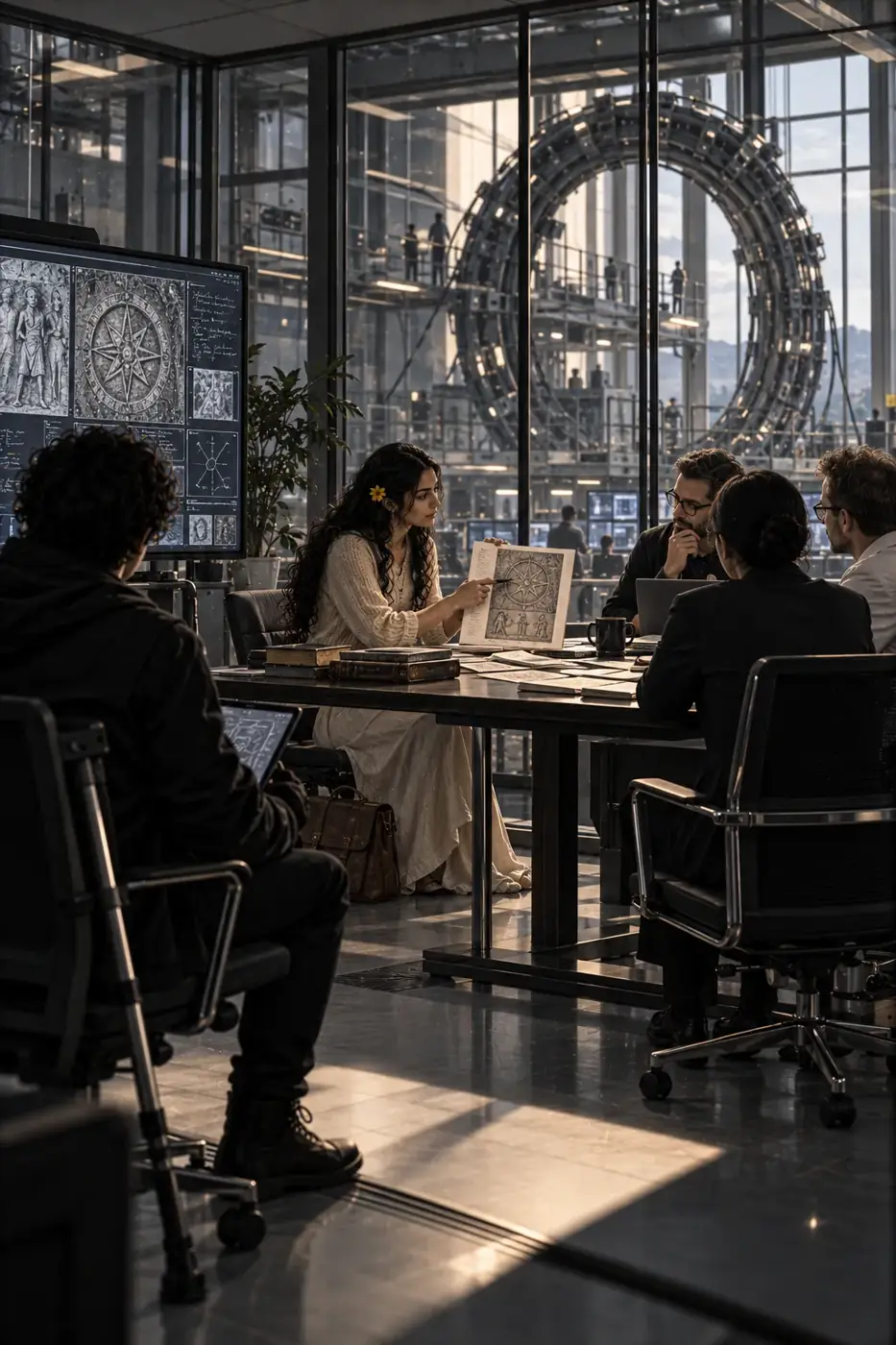
For a moment, Ray had no answer. He was used to people challenging his methods, but not often with such calm certainty. Nila continued, explaining how cultural and linguistic data could be organised into practical preparation for a visitor: likely forms of address, taboo subjects, ritual gestures, social hierarchies, and the difference between a symbol’s literal meaning and its emotional weight.
She made the unfamiliar feel legible without pretending it was simple. The way she explained things stirred something in Ray that he had not expected to feel in a meeting room. Her patience reminded him, faintly and painfully, of his mother. It was not that Nila was like his mother in every way. It was the sensation of being allowed to ask a question without being made to feel foolish.
When the interview ended, the team offered her a role in Project Omnia. Her work would help select and interpret cultural profiles, prepare language and context briefings, and help the team understand the realities they were attempting to reach. She would not operate the Gate or make technical decisions; that was not her field. But without her, the project could reach a world and still fail to understand it.
Nila stared at the machine, then at the people who had built it. Her scholarly life had been spent examining humanity’s stories about other worlds. Now someone was asking her to help investigate whether those worlds might be accessible.
“Yes,” she said at last. “I want to be part of this.”
As the meeting broke up, Liam pointed to a set of unfamiliar symbols on the display. “I thought these were just decorative marks in the profile.”
“They might be,” Nila said. “Or they might mark a boundary. In some traditions, a repeated symbol is not decoration; it tells you where you are allowed to stand, what you are allowed to touch, or who is permitted to speak.”
Theo looked at the Gate. “So the universe might have a sign that says, ‘Please keep off the grass.’”
“Or something much less forgiving,” Nila replied.
The smile slipped from Theo’s face. Ingrid zoomed in on the symbol, and Dr. Cole asked Nila to document every possible interpretation before the next test.
Ray watched the team adjust its assumptions around her explanation. He admired that she could make them laugh without making the subject feel small, and make them serious without pretending to know more than the evidence allowed.
Ray watched her sign the initial documents. He told himself that he was interested in the project’s new specialist. It was a reasonable explanation. It was also not the whole truth.
Nila Metilda arrived carrying a leather satchel full of books and a notebook crowded with careful handwriting. She had the composed manner of someone accustomed to listening before speaking, but her eyes moved quickly. She noticed the symbols on the wall displays, the researchers’ exhausted faces, and the way Ray stood slightly apart from the group as if distance were a habit he had learned to wear.
She had been recruited because the Gate’s readings were no longer meaningless noise. They were beginning to resemble recurring patterns: symbols, structures, possible language fragments. The team could reach toward a universe and still be helpless once it made contact. A traveler might arrive without understanding the people around them, the customs governing their behavior, or the myths that shaped the world they entered.
Nila’s work would help them build a cultural and linguistic map before anyone crossed.
Ray expected her to be useful. He did not expect her to look at a sequence of marks and explain not only what they might mean, but what kind of fear, hope, or sacred obligation could have caused someone to carve them.
“Symbols are never only symbols,” she said. “They carry the people who made them.”
Ray looked at her as though she had opened a door in a wall he had mistaken for solid.
Theo volunteered to show her around the laboratory. He began with the neural interface, moved to the sensor racks, and somehow turned the explanation into a comparison with a badly organised kitchen.
“So the Gate is the stove,” Nila said, following him with polite concentration, “the signal is dinner, and the universe is the guest who may or may not arrive?”
“Exactly,” Theo said, delighted.
“That metaphor has at least four scientific problems,” Ingrid called from the console.
“Five,” Ray said without looking up.
Nila turned towards him. “You counted?”
“I noticed them.”
“Of course you did.” Her smile was brief and warm. Ray looked back at his monitor with the urgency of someone who had just remembered a critical calculation.
Liam stepped aside to let her see the instrument rack. “If anything looks like a biscuit, that is not its official name.”
“Why would a scientific instrument look like a biscuit?” Nila asked.
“Because I named it Biscuit.”
Dr. Cole appeared behind them. “You named one calibration unit Biscuit. The official name is Calibration Unit Four-B.”
“Biscuit Four-B,” Liam offered.
“No.”
Pip’s screen lit up: BISCUIT FOUR-B: CALIBRATION DRIFT DETECTED.
Everyone looked at the display. Liam slowly pointed at Pip. “See? It understands me.”
“It understands the calibration data,” Ingrid said.
“Let me have this.”
By the end of Nila’s first week, she had learned three things about Project Omnia. The Gate was more complicated than any description could capture, the scientists argued with affection disguised as professional criticism, and the coffee rota was a source of greater conflict than the experimental schedule.
Theo had created a colour-coded chart. Ingrid had objected that it assumed everyone worked the same hours. Liam had borrowed Elena’s mug and forgotten where he left it. Elena had written THIS MUG IS UNDER MEDICAL SUPERVISION on a strip of tape and attached it to the replacement.
Ray studied the rota for nearly a minute. “Is this designed to optimise caffeine distribution or reduce workplace conflict?”
“Both,” Theo said.
“Then it needs two separate models.”
Nila laughed so suddenly that she covered her mouth. Ray looked up, startled by the sound, and forgot what he had been about to say.
Pip’s screen displayed a tiny heart.
“Don’t,” Ray told it.
The heart changed into a graph labelled CORRELATION: STRONG.
Nila laughed again. This time, Ray could not quite hide his smile.
Their first conversations were professional. Nila asked precise questions; Ray answered with diagrams, numbers, and brief explanations. She was not embarrassed when she did not understand a technical term. She simply asked him to translate it into human language. In return, she explained mythology without making it sound like a museum full of dead beliefs.
When she described how stories of fallen beings could change across cultures, Ray found himself listening after the useful information had ended. Her voice carried a steadiness that reminded him of his mother reading beside his bed. The resemblance unsettled him, because it touched a part of his life he kept locked away.
He began noticing small things: how she tucked a loose strand of hair behind her ear when thinking, how she hummed under her breath while reading, how she treated junior staff with the same respect she gave the director. He told himself these were observations, not feelings. He had always been good at naming things in ways that made them easier to control.
Ray did not know how to approach Nila in person. In the laboratory, he could talk for hours about signal filters, calibration, and the stubborn behaviour of the Gate. With her, every ordinary sentence seemed to require a calculation he had never learned to perform.
Then he went back to his desk and opened an old private interface he had built years earlier. It was never meant to become a disguise. At first, it was only a way to test whether a conversational system could respond with warmth as well as accuracy.
He should have spoken to her honestly. Instead, fear persuaded him that anonymity was safer than rejection.
The first message appeared on Nila’s screen after a long day of cataloguing symbols.
“You have been staring at the same page for twenty minutes. Either the page is brilliant or it has personally offended you.”
She looked around the empty office. The interface showed no name, only a plain chat window.
She typed, “And you are?”
“A person with a strong suspicion that you need tea.”

“That is not an answer.”
“It is an excellent first step toward one.”
She laughed before she could stop herself. It was a small laugh, surprised out of her by a stranger who seemed to understand that her day had been long.
“Are you one of the researchers?”
“Would it make you less suspicious if I said yes?”
“No. It would make me more suspicious.”
“Then I’ll have to earn a better answer.”
Nila should have closed the window. Instead, she asked what kind of tea he recommended. Their conversation wandered from tea to books, from books to the ridiculous habits of brilliant scientists, and from there to the question of whether a person could be lonely in a room full of people.
She did not know who was writing to her. She knew only that the stranger seemed to hear the things she rarely said aloud.
A few days later, a simple sketch appeared in the chat. It was a drawing of Nila seated by the lab window, her notebook open, her expression caught between concentration and a private smile. It was not a perfect likeness. It was more intimate than a photograph because it had been made by someone who had watched her carefully.
She stared at it for a long time.
“You draw?” she typed.
“Sometimes.”
“You drew me.”
“You were there.”
“That is not the same as explaining why.”
The reply took longer this time. “Some moments seem worth keeping.”
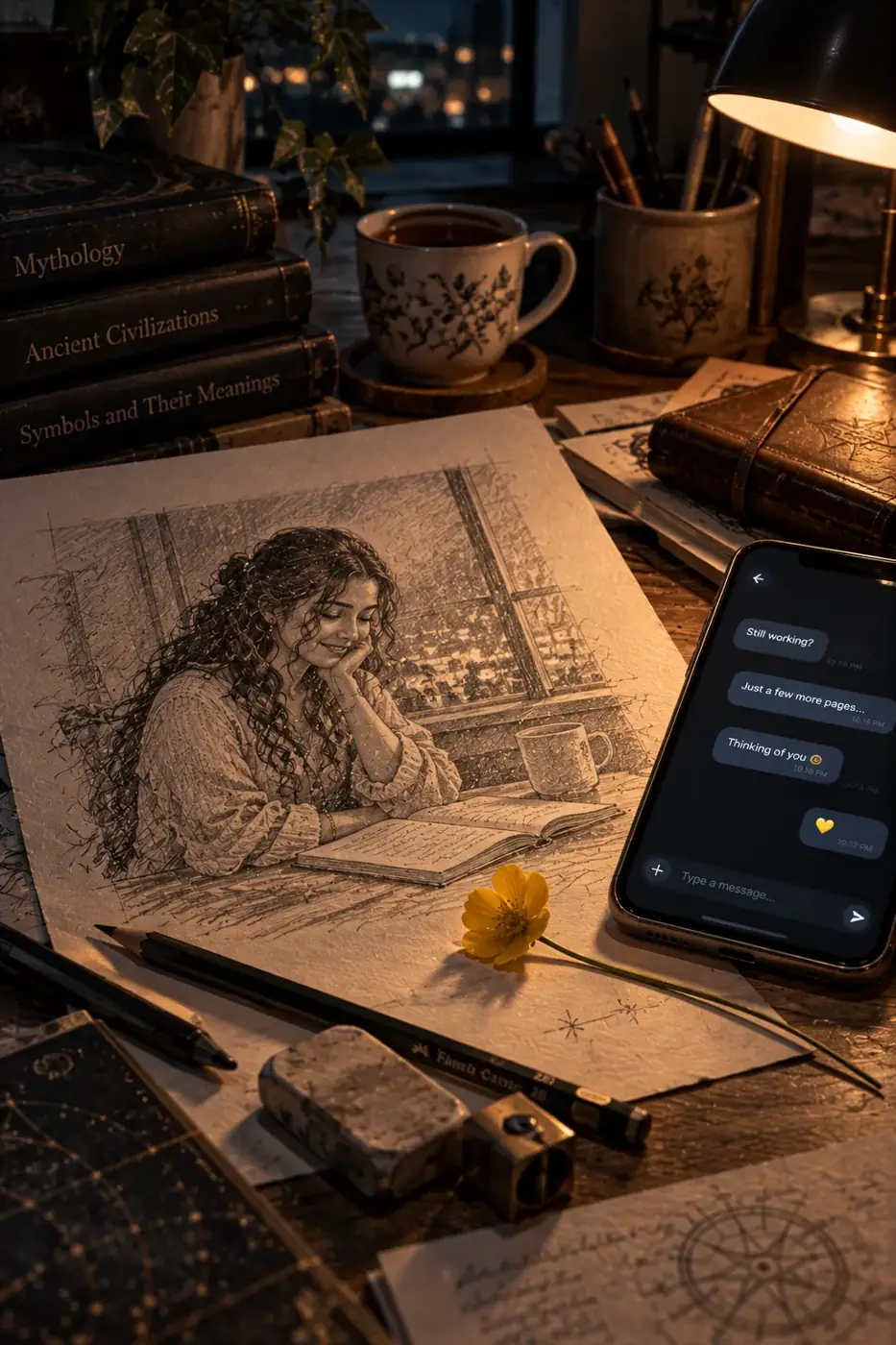
Nila felt an unfamiliar warmth rise in her chest. She had recently stepped out of a relationship that had taught her to distrust grand declarations. This was different. No promises, no demands, no pressure to explain herself before she was ready. Just a sketch and a sentence that left her free to decide what it meant.
“Then I’m keeping it,” she wrote.
“Good.”
“Still not telling me your name?”
“Not yet.”
She tilted her head at the screen. “You are either very shy or very annoying.”
“I have been accused of both.”
“Fine. Until you tell me, I’m calling you Crayon.”
“Why Crayon?”
“Because you draw outside the lines.”
He stared at the message longer than he intended. Then he typed, “If I’m Crayon, you’re Buttercup.”
“Because I’m yellow?”
“Because you make ordinary things feel like they might grow.”
Nila read that twice. She did not reply immediately. When she finally did, she sent a small yellow flower. He saved the message as if it were something fragile.
Their conversations became a small ritual. Some nights they spoke for ten minutes. Other nights, the clock moved past midnight before either noticed. Nila told Crayon that she wanted to sing professionally one day, even though she had built a life around scholarship and teaching. She told him she loved old stories because they allowed people to admit fear without saying the word fear.
Crayon told her that he liked making things work, especially things other people had given up on. He did not tell her about the accident, the supports he used, or the boy who had once asked whether God could bring his parents back. He was not ready to place those pieces of himself in anyone’s hands.
“Can we make rules?” Nila asked one night.
“For a conversation?”
“For this. Whatever this is.”
“Of course.”
“Rule one: no pretending to be perfect.”
“Agreed.”
“Rule two: no forcing the other person to answer something they aren’t ready to answer.”
He hesitated. The rule felt like kindness and warning at once. “Agreed.”
“Rule three: if one of us is having a terrible day, the other one must try to make it less terrible. Even if the only available solution is a terrible joke.”
“I can offer several terrible jokes.”
“I’m sure you can.”
“And rule four?” he asked.
Nila thought for a moment. “We don’t disappear without saying why.”
The cursor blinked. Ray’s hands hovered over the keyboard. He knew that rule was the one he was most likely to break.
“Agreed,” he wrote.
She believed him. That was what made the promise beautiful. It was also what made it dangerous.
One evening Nila sent him a voice note. She warned him it was only a fragment, something she had been practising between work and dinner. Then she sang softly, without accompaniment. The melody was warm and a little hesitant, as though she were offering him a room inside herself and waiting to see whether he would treat it gently.
Ray played it once. Then again. On the third replay, he set his hands flat on the desk because he had begun to tremble.
He had spent years learning how to remain calm in rooms where alarms sounded and numbers fell. A few seconds of Nila’s voice undid him more completely than any crisis.
“You sing like you’re telling a secret,” he wrote.
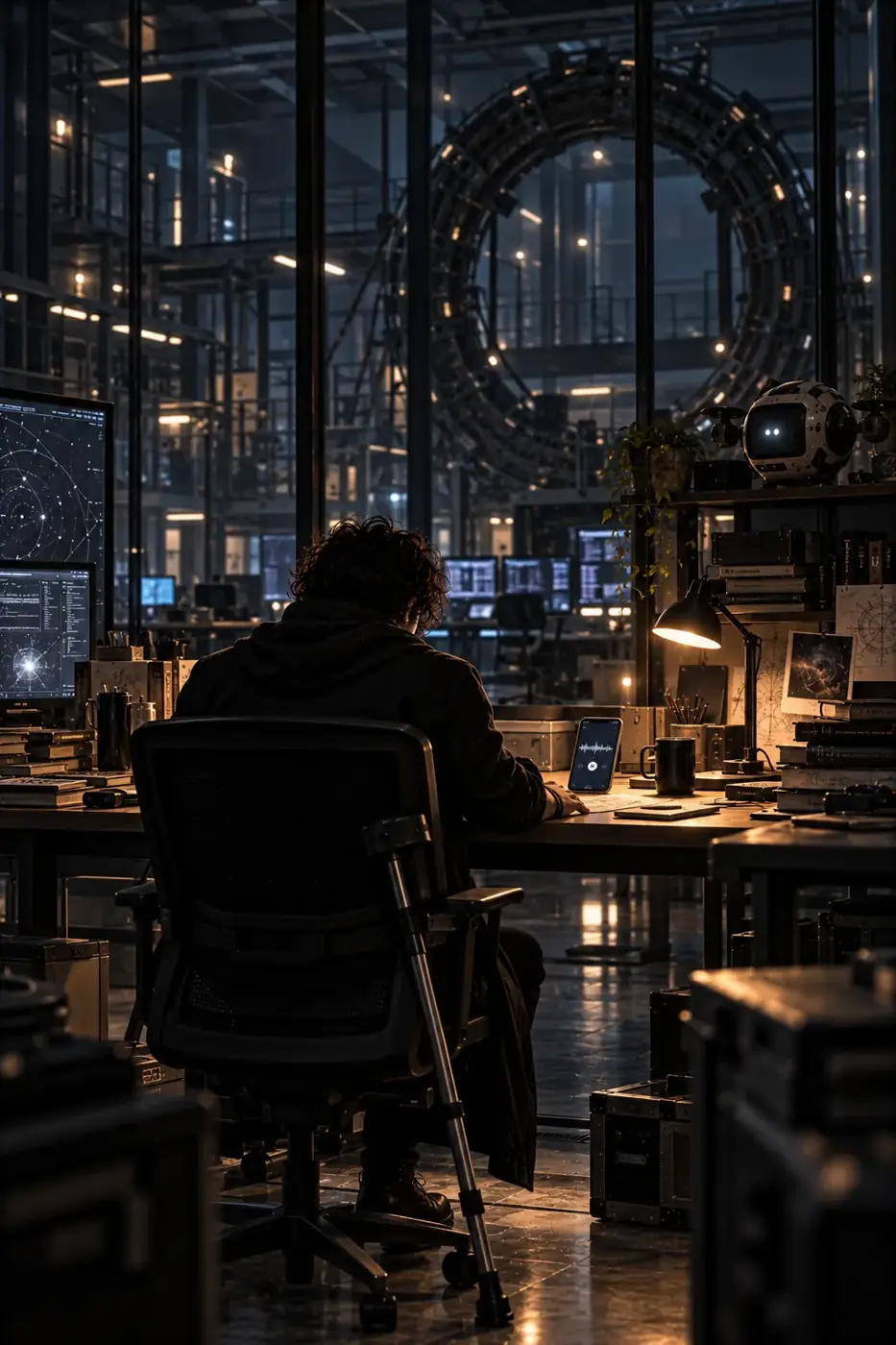
“Maybe I am.”
“What secret?”
“That I wish I had the courage to do this in front of people.”
“You do have the courage. You just haven’t given it a stage yet.”
She sent a laughing emoji. “That sounded suspiciously like encouragement.”
“It was meant to.”
“What do you do when you’re afraid?”
“Build something.”
“And does it work?”
“Sometimes. Sometimes I build the wrong thing.”
“Then let me tell you a secret, Crayon. You don’t have to solve every feeling before you’re allowed to have it.”
He sat very still. It was the kind of sentence his mother might have said to him when he was eight, before the world split into before and after. Nila did not know that. Somehow, she had found the same locked room.
That night, he drew her again, not from the lab but from memory: a small figure standing under a sky crowded with stars. He sent it with no explanation. She replied, “You made me look like I belong somewhere.”
He wrote, “You do.”
Neither of them asked where.
Their closeness grew through ordinary details. Nila told him when a lecture went badly, when a student asked a question so good it made her forget her prepared answer, when the rain trapped her in a bookshop for an hour. Crayon told her when Pip had stolen a screwdriver, when a simulation had failed in a spectacularly expensive way, when he had forgotten lunch because he was trying to repair a filter.
She learned that he disliked being pitied. He learned that she disliked being praised as though her ambitions were charming hobbies. She wanted to sing, not merely dream about singing. He wanted to be understood, not admired from a safe distance.
One night she asked, “If you could leave everything behind for one day, where would you go?”
“Somewhere quiet. Near water.”
“Would you go alone?”
He typed yes, deleted it, then wrote, “I used to think I would.”
“And now?”
“Now I think the right person can make silence feel less empty.”
Nila read the line with her lips parted. She wanted to ask whether he was talking about her. She wanted to ask whether she was allowed to hope. Instead she wrote, “That is a dangerous thing to say to a woman who likes stories.”
“I know.”
“Do you?”
“No,” he admitted. “I’m learning.”
She smiled at the screen. “Then learn slowly. I’m not in a hurry.”
It was the first time she had offered him a future, however small. He carried the sentence into the lab the next morning like a hidden light.
The day Nila received an unexpected message from her former partner, she tried to pretend it had not affected her. She worked through lunch, corrected a translation, and sat through a meeting without once looking toward the door. That night, Crayon noticed the difference.
“You are using very formal punctuation,” he wrote. “Something is wrong.”
“Perhaps I have become a formal person.”
“Unlikely. You once threatened to throw a book at me through the screen.”
“You deserved it.”
“I probably did. Buttercup?”
She stared at the nickname. There was no demand in it, only an open door.
“I heard from someone I hoped I was finished hurting over,” she wrote. “I thought I was stronger than this.”
“Being hurt again doesn’t mean you have gone backward.”
“I’m tired of being careful with my own heart.”
“Then tonight you don’t have to make any decisions about it. You can be tired. You can be angry. You can say the unpretty thing.”
She typed and erased several replies before writing, “I miss who I was before I started apologizing for needing kindness.”
Ray’s chest tightened. He wanted to tell her that she should never have had to apologize. He wanted to tell her he would never ask her to make herself smaller. He also knew he was hiding the truth from her, and every tender thing he offered was becoming more complicated because of it.
“You don’t have to earn kindness,” he wrote. “Not from me.”
Nila held the phone against her chest for a moment. She did not know who he was. But for that night, she believed the sentence.
Their first truly difficult conversation began with a joke and ended in silence. Nila asked whether Crayon had ever been in love. He answered that he had spent so long preparing for the possibility of loss that he had sometimes mistaken distance for safety.
“That sounds lonely,” she wrote.
“It is efficient.”
“Efficient is not the same as alive.”
He read the sentence several times. “You make that sound simple.”
“It isn’t simple. It’s just true.”
She told him that she was afraid of becoming attached to a person who existed only when a screen lit up. He told her he was afraid that being known would make him less lovable. She asked whether he thought she was so shallow that a face, a disability, or a painful history could make her turn away.
He nearly told her everything then. His name. His work. The accident. The truth that he had been standing only a few rooms away when she spoke to the anonymous person she trusted.
Instead he wrote, “I don’t know what you would do. That is what scares me.”
“Crayon, I can’t promise I’ll never be surprised. I can promise I won’t judge a truth before I hear it.”
He closed his eyes. There it was, the path he needed to take. He could have walked it. Instead, he said good night.
Nila waited for another message. None came. She told herself he had needed time. Ray told himself he would tell her tomorrow. Both of them went to sleep holding a truth that had almost been spoken.
After that, their conversations changed. Nila became more honest, not less. She spoke about the parts of herself she had hidden to make a relationship easier. She admitted she wanted to sing on a stage, to act in stories that made people feel less alone, and to keep teaching because she loved the moment when a student discovered a new way to see the past.
Crayon listened. Sometimes he asked questions. Sometimes he made a small drawing. Sometimes he simply stayed online while she worked, the quiet presence of another person making the night feel less wide.
“What do you want from me?” she asked one evening.
Ray’s first instinct was to say nothing. Nothing would protect her. Nothing would preserve the fragile thing they had built. But nothing was also a lie.
“I want to be someone you can tell the truth to,” he wrote. “Even when it’s inconvenient.”
“That’s a good beginning.”
“And what do you want?”
“To be seen without having to perform. To be loved without having to become easier to love.”
His eyes blurred. He knew how much she deserved that. He also knew that if she understood who was behind the screen, she might feel the whole relationship had been built on a trick.
“I see you,” he wrote.
They did not fall in love in a single dramatic moment. They arrived there by repetition: good mornings, reminders to eat, silly arguments over whether the moon looked lonely or merely far away, sketches sent at midnight, songs shared when Nila could not explain her mood.
She began to tell him things before she told anyone else. He began to imagine her voice in the quiet parts of his day. When something went right in the lab, he wanted to tell her. When something went wrong, he wanted to hear her remind him that failure was an event, not a verdict.
One night, she asked him to promise that he would not vanish without warning.
“I promise,” he wrote.
“Not because I need you to be available every second. I don’t. I just need to know that if you leave, it won’t be because you decided I was too much.”
Ray stared at the message. He could not promise he would never hurt her. He could promise that he would not deliberately make her feel small. But he had already kept the most important truth from her, and the promise seemed to expose the shape of his cowardice.
“I won’t leave because you’re too much,” he wrote at last.
“Good,” she replied. “Because sometimes I am a lot.”
“Sometimes I am a locked laboratory with terrible lighting.”
“Then I will bring a lamp.”
He laughed aloud. Pip, stationed on the shelf, displayed a tiny warning triangle, as if laughter itself required authorization.
For a little while, Ray allowed himself to believe that love could be built out of small, ordinary promises. He did not yet understand that the truth was one of them.
The next morning, Nila woke to a message from Crayon.
“Good morning, Buttercup. Have you eaten?”
She stared at the screen from beneath her blanket. The message was simple enough to be ordinary, but that was exactly why it touched her. Her former partner had often made affection feel like a prize she had to win after an argument. Crayon asked whether she had eaten as if her wellbeing were not a reward but a basic fact worth checking.
“Good morning,” she typed. “I had coffee.”
“That is a beverage. I asked about food.”
“Are you my doctor now?”
“No. Your doctor would probably have more authority and better handwriting.”
She laughed into her pillow.
“I’ll eat in a minute,” she wrote.
“I will believe you when you send evidence.”
“Evidence?”
“A photograph of breakfast. Preferably not a photograph of coffee pretending to be breakfast.”
She sent him a picture of toast and a banana.
“Acceptable,” he replied. “The banana appears to be cooperating.”
“You are impossible.”
“Frequently.”
She put the phone down and ate. When she returned, there was another message waiting.
“Thank you for taking care of yourself.”
It was such a small sentence. It asked for nothing. It did not turn her choices into a test of loyalty. Nila sat quietly with the phone in her hand, surprised by how much tenderness could fit into six ordinary words.
She typed, “You make it sound like something I’m allowed to do.”
“You are.”
She did not tell him that her eyes had filled with tears. She sent him a yellow heart instead.
Ray looked at the heart for a long time. He wanted to be the person who could say these things to her openly, face to face. He told himself he was waiting for the right moment. He did not admit that he was afraid the right moment would ask him to be brave.
“Do you ever wonder what I look like?” Nila asked one night.
Ray stopped typing.
“Of course,” she continued. “I know your handwriting from the sketches. I know your sense of humor. I know you are probably the kind of person who corrects a machine when it makes a tiny mistake. But I don’t know your face.”
“I wonder what you imagine.”
“I imagine someone with tired eyes.”
“That is unfairly accurate.”
“And messy hair.”
“Possibly.”
“And a terrible habit of answering questions with questions.”
“That sounds like a very irritating person.”
“He is. I’m growing fond of him.”
Ray smiled despite himself. He could have sent a photograph then. He could have told her his name. The image folder on his desktop contained a recent picture, one he had taken after a colleague insisted he needed a new staff profile. His hand moved toward it, then stopped.
“Would it change anything if I looked different from what you imagine?” he asked.
Nila considered the question. “I don’t think a face would change the person I’ve been speaking to. But hiding forever would eventually change how I felt about him.”
The honesty in her answer hurt because it was not a threat. She was giving him a boundary before he crossed it.
“I don’t want you to feel trapped by this,” he wrote.
“I don’t. I chose to keep talking to you. I’m choosing it because I like you. But I need you to understand that curiosity isn’t the same as permission to keep me in the dark forever.”
“I understand.”
“Do you?”
He almost typed yes. Instead, he wrote, “I’m trying to.”
“That’s a better answer.”
She sent a small sketch of a door with a yellow flower beside it. “You can open it when you’re ready, Crayon. Just don’t ask me to pretend the door doesn’t exist.”
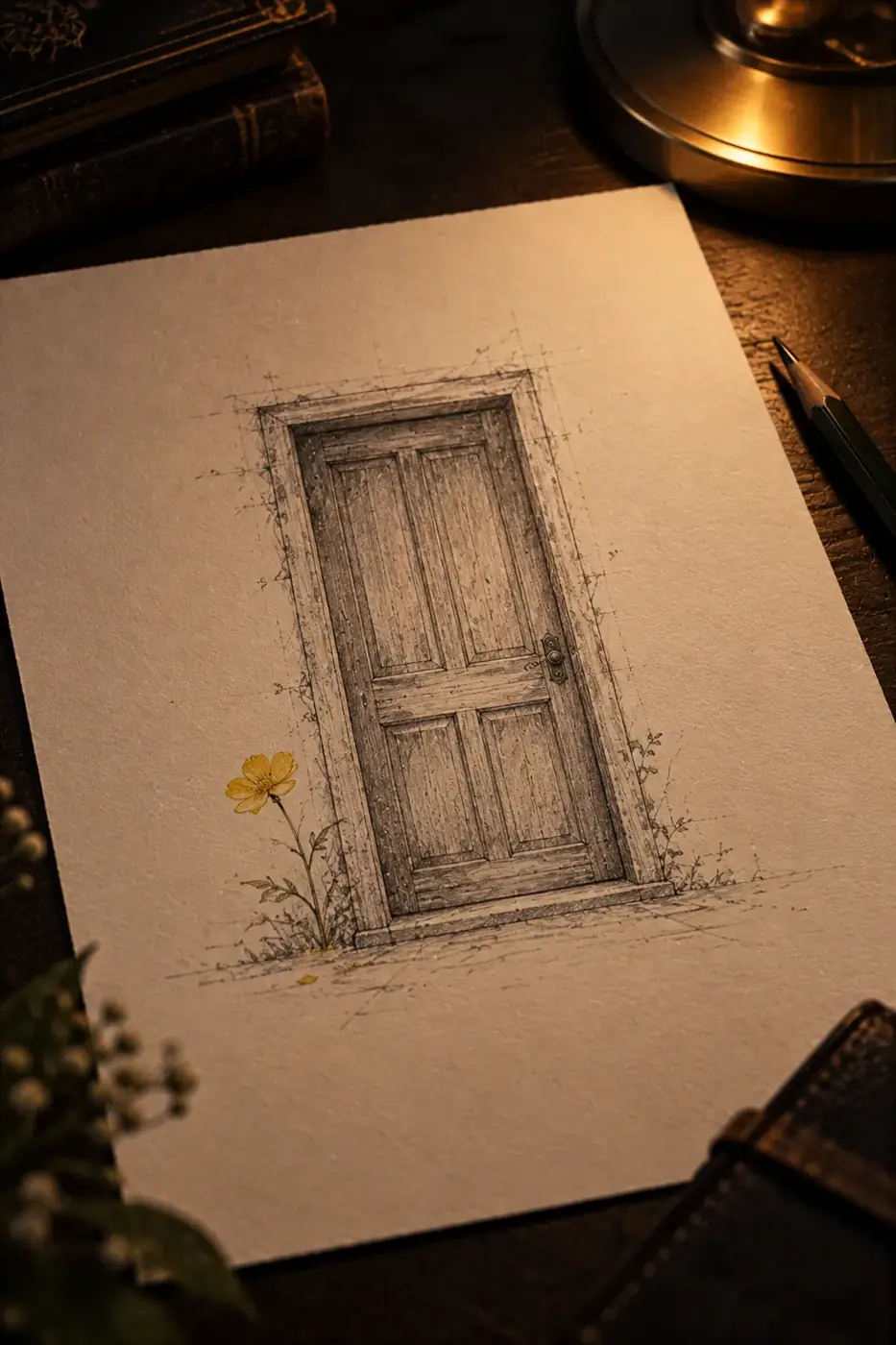
Ray saved the picture beside the one he had drawn of her. For the first time, he felt the cost of anonymity not as a distant risk, but as a debt that was growing every day.
Their conversations began to collect small traditions. On Mondays, Nila sent a line from a poem she liked. On Wednesdays, Ray sent a drawing of something he had noticed at the lab. On Fridays, they asked each other one question that could not be answered with yes or no.
“What is a memory you would keep if you could only keep one?” she asked.
Ray looked at the ceiling. He could have chosen the picnic, but the memory was too large and too painful to place in a casual message. He could have chosen the first time he repaired something on his own, or the first paper that had been accepted for publication. None of those was the answer he wanted to give.
“A late afternoon beside a lake,” he wrote. “The sun was going down. Someone I loved told me that not knowing wasn’t a failure.”
Nila read the sentence carefully. She wondered whether the person was his mother, a teacher, or someone he had never mentioned. She did not push.
“I would keep the first time I sang for someone and they listened all the way to the end,” she wrote. “Not because I sang well. Because they didn’t make me feel silly for wanting to sing.”
“I would listen to every song you ever send me.”
“That is a dangerous promise. I have terrible practice recordings.”
“I am prepared.”
“You say that now.”
“I have survived Pip’s early software updates. I can survive a wrong note.”
She laughed, then sent him a recording of a melody she had been working on. The first few seconds were uncertain. By the end, her voice had settled into something clear and beautiful.
Ray did not answer immediately. Nila wondered whether she had embarrassed herself.
Then his message arrived.
“I think the universe should make room for this.”
She held the phone against her heart. “You can’t say things like that.”
“Why?”
“Because I might believe you.”
“I hope you do.”
For a while, neither of them typed. They stayed connected, each imagining the other at the far end of the silence. Their worlds were still separate, but the distance between them had begun to feel inhabited.
Rain struck the windows hard enough to blur the city lights. Nila had been working on a translation for hours, but her concentration had dissolved. She opened the chat.
“Tell me something,” she wrote.
“Something.”
“I dislike you.”
“Good. I was worried we had become predictable.”
She smiled. “Tell me something true.”
Ray watched the cursor blink. There were so many truths he had withheld that choosing one felt like choosing which lie to leave standing.
“I am afraid of being known,” he wrote.
Nila did not respond with a joke. “Why?”
“Because once someone knows the parts of me I can’t fix, they might decide the rest isn’t worth the trouble.”
She sat up. The sentence sounded too old for a passing mood. “Crayon, being loved isn’t a performance review.”
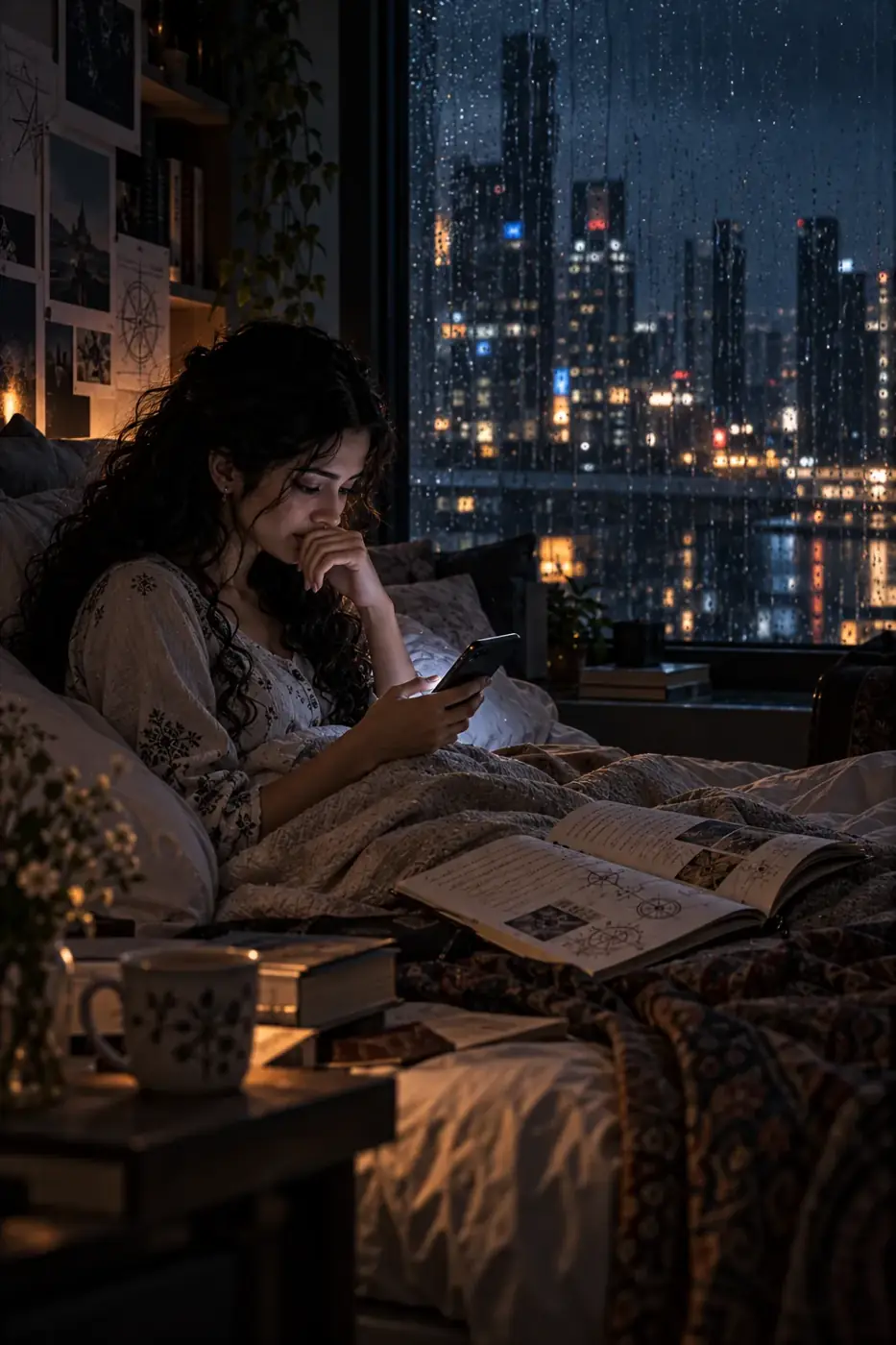
He let out a breath he had not realized he was holding.
“You can be brilliant and still be frightened,” she continued. “You can be kind and still make mistakes. You can be hurt and still hurt someone else. None of those things makes you impossible to love. But you have to let people see enough of the truth to choose you honestly.”
He read the message once, then again. She had come close to the very thing he was doing wrong without knowing it.
“What if the truth disappoints you?” he asked.
“Then I will be disappointed. I won’t pretend otherwise. But at least I’ll be disappointed in the real person, not in a shadow.”
The rain moved across the glass in long, silver lines. Ray wanted to tell her. He wanted to say, I am closer than you think. I see you in the lab. I know the sound of your footsteps in the corridor. I have watched you laugh at things I said while pretending not to know that I was the one who said them.
Instead he wrote, “You deserve the real person.”
“Yes,” she replied. “I do.”
It was not cruel. It was the simplest truth she could offer him, and he knew it.
The next week, Nila mentioned a colleague who had invited her to a music event. She described the venue, the musicians, and the fact that she was considering going because she had not heard live music in months.
Ray found himself asking too many questions.
“Who is going?”
“Some friends from the department.”
“Is he one of them?”
She paused. “Who?”
“The colleague.”
Nila leaned back from her desk. A smile began to form, slow and disbelieving.
“Crayon, are you jealous?”
“No.”
“You answered too quickly.”
“I am gathering context.”
“You are gathering context about a man who invited me to a concert.”
“Correct.”
“Why?”
Ray rubbed his forehead. He could have blamed curiosity. Instead, he typed, “Because I don’t like imagining you being swept off your feet by someone who can actually take you to a concert.”
Nila’s smile softened. “That is the first honest thing you’ve said about it.”
“It is not a very dignified feeling.”
“Feelings rarely arrive dressed for a formal event.”
He laughed. “Are you going?”
“Yes. I want to hear the music. I am not going because I am looking for someone to replace you.”
He stared at the word you. It was an extraordinary thing to be claimed by someone who had never seen his face.
“You don’t owe me an explanation,” he wrote.
“I know. I’m giving you one because I want to. There’s a difference.”
He felt ashamed of the jealousy, but he also felt something else: the realization that Nila was not a dream waiting in a box. She had friends, ambitions, a world beyond their messages. Loving her meant wanting that world to grow, even when it frightened him.
“Then go,” he wrote. “Listen to everything. Tell me about the best song afterward.”
“And if I dance?”
“I will demand a full review.”
“You’ll get one, Crayon.”
When she returned that night, she sent him a voice note describing the music, the lights, the joy of being in a crowd where everyone was listening to the same thing. Ray listened until the note ended, then asked her to tell him the story again. He could not take her there. He could still be the person she wanted to tell.
Nila began using the nickname even when she was tired or distracted.
“Crayon, I’m late.”
“Crayon, tell me whether this translation sounds right.”
“Crayon, I saw a yellow flower and thought of you. This is your fault.”
Each time she wrote it, Ray felt both chosen and hidden. The nickname made their private world feel real. It also allowed him to avoid the name his parents had given him.
One night, she asked, “Do you have a name you like?”
“My name?”
“A name for yourself. Something that feels like you.”
He thought about it. “I have a name.”
“I know. I mean a name you would choose if nobody else had chosen it for you.”
He did not know how to answer. For years, he had been trying to become a person who could survive what had happened, not a person who could choose who to be.
“What would you choose for me?” he asked.
“Crayon is already taken.”
“Then what?”
She considered. “Someone who makes tools out of grief. Someone who is more gentle than he thinks he is. Someone who keeps drawing doors and is terrified to walk through them.”
“That is a very long name.”
“I’m a scholar. We specialize in long names.”
He smiled, then wrote, “And what name would you choose for yourself?”
“Buttercup,” she replied. “I like that it sounds small and bright. People assume small things are fragile. They forget that flowers grow through concrete.”
Ray’s smile faded into tenderness. “You are not small.”
“I know. But I’m allowed to be soft.”
“Yes,” he wrote. “You are.”
She sent him a yellow flower, then a message: “Someday, I want to know the name your parents gave you.”
Ray stared at the sentence until the screen dimmed. It was the closest she had come to asking for his identity without demanding it. He knew he should have answered. He knew he had no right to keep accepting her trust while withholding the truth.
“Someday,” he wrote.
Nila accepted the answer, but she did not forget it.
The words came on an ordinary night. Nila had been telling him about a student who had stayed after class to ask whether the myths people inherited could change the way they saw themselves. She had answered that stories could offer a mirror, but no story should become a cage.
“Sometimes I think I teach because I want people to feel less alone inside the questions they have,” she wrote.
Ray answered, “You do that for me.”
She looked at the message. “I’m not sure I understand.”
“When I speak to you, I feel like I can ask things I’ve spent years refusing to ask. Not because you always have answers. Because you don’t make me ashamed of the questions.”
Nila sat still. The words had reached beyond flirtation into a place where she had to be careful.
“Crayon,” she wrote, “I need to ask you something, and I need you to answer honestly.”
“I’ll try.”
“Are you beginning to love me?”
He stopped breathing for a moment. The honest answer was yes. The honest answer was also that he had allowed her to fall for a person without knowing who that person was.
“Yes,” he wrote.
Nila read the word, and the room seemed to tilt around her. She had not expected the answer to make her feel both relieved and afraid.
“I think I’m beginning to love you too,” she wrote.
Ray put a hand over his mouth. He did not feel victorious. He felt as if someone had placed a precious object in his hands and he had suddenly become aware of every way he could drop it.
“I don’t want to rush you,” he wrote.
“You aren’t.”
“I don’t want you to feel you owe me anything.”
“I don’t.”
“I want you to be free to change your mind.”
Nila’s eyes softened. “I want that for you too. But right now, I love the person who talks to me here. I love how he listens. I love how he makes me laugh when I’m tired. I love that he never makes my dreams sound childish.”
Ray read the message through tears he could not explain away.
“I love you, Buttercup,” he wrote.
She pressed her fingertips to her lips and whispered the words before sending them back. “I love you too, Crayon.”
The room around Ray was unchanged. The Gate stood beyond the glass. The lab hummed with its usual quiet machinery. Yet for the first time in years, the future seemed to contain something other than work and grief.
He should have told her his name that night. Instead, he saved the conversation, as if saving the words could save the moment from what would come.
Their intimacy deepened, and with it came a night when a private conversation turned more intense than either had expected. They spoke about longing, loneliness, and the desire to be held by someone who did not ask them to become different first. Nila admitted that she was frightened by how much she trusted a person she had never met. Ray admitted that he thought about her even when he was trying not to.
The conversation was tender, but afterward Nila lay awake with a new worry. She had promised herself she would not confuse emotional safety with surrendering her judgment. She cared for Crayon. She also needed to know that the connection was safe, and that the person behind it was not using anonymity to gain access to her life.
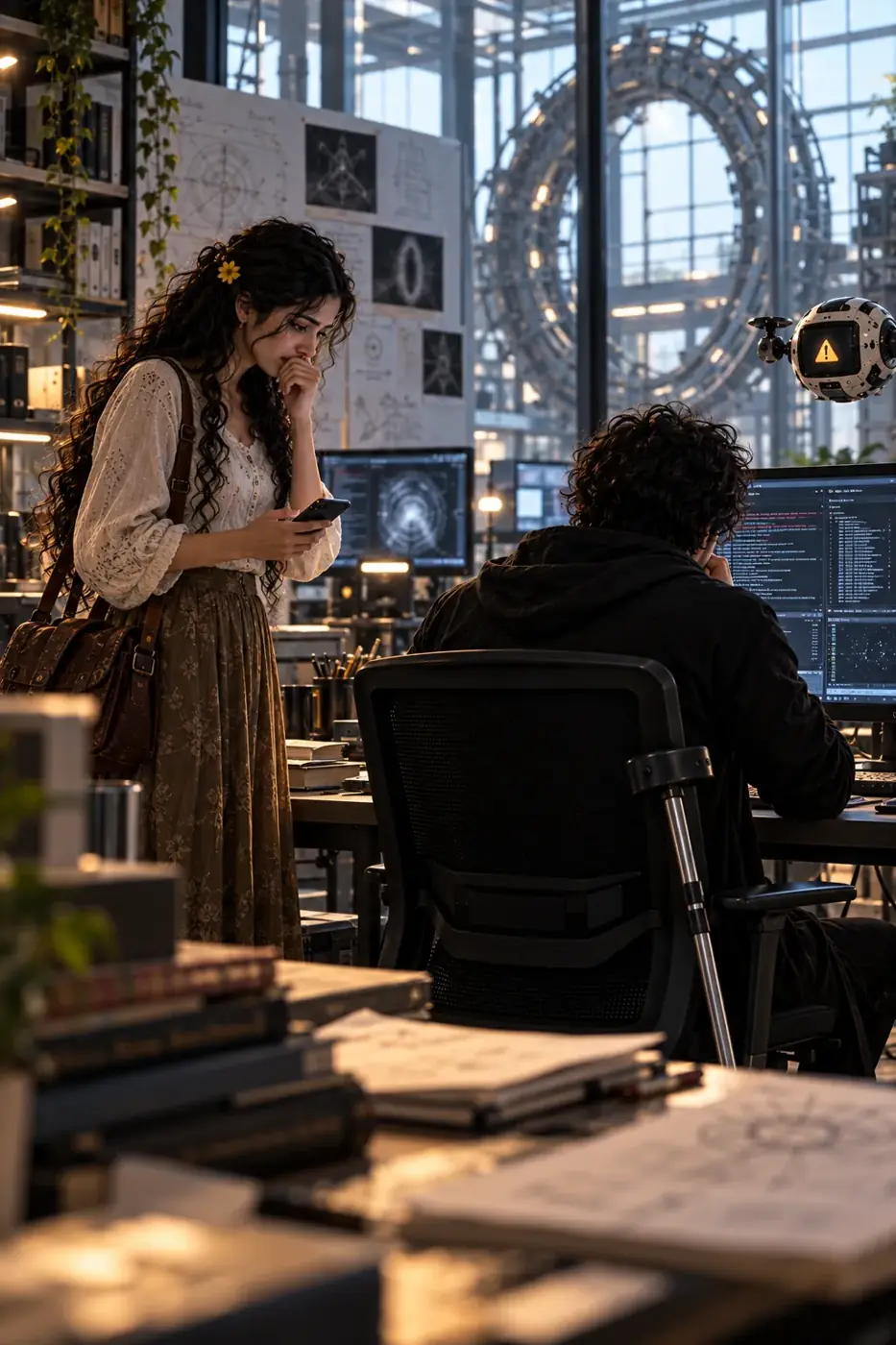
The next day she went to Ray in the lab, unaware that the person she was worried about stood directly in front of her.
“I need your help with something,” she said. “The private interface I use has been acting strangely. Can you check whether it can access my files or track me?”
Ray felt the floor drop away beneath him. He did not let it show.
“Of course.”
He checked the permissions and logs, limiting his review to security behavior. He did not open their messages. He did not search her personal data. When he finished, he told her what he had found and explained how she could disable the interface if she wanted to.
“Did you look at the conversations?” she asked.
“No.”
She searched his face, looking for a reason not to believe him. Ray held her gaze. He had respected that boundary. It was the one thing he could still do correctly.
“Thank you,” she said. “I was afraid I’d made a mistake.”
“You haven’t made a mistake by wanting connection.”
Her expression changed. She seemed about to say something more, but the lab door opened and another researcher called her away.
For a few days, their messages became cautious. Hi. Good morning. A brief question about work. A polite goodnight. Ray tried not to press. He knew he had no right to demand trust from someone he had kept in the dark.
After a few cautious days, she returned to the chat as she used to. She did not forget her concern. She did not stop caring. She chose to continue, with the intention of asking harder questions when she was ready.
Ray understood that her trust was not permission to hide forever. He simply did not yet know how to stop hiding.
There were days when Ray almost told her everything in a rush. He would open the message window and type, “My name is Ray Ezhil.” He would add, “I work beside you.” Then he would imagine her face when she understood how often they had stood in the same room without sharing the truth.
He deleted the words.
He told himself he was protecting the relationship until he could explain the accident, his fear, his history, and the way being seen had always felt like standing under a bright light with nowhere to hide. But every day he waited, the explanation became harder. The longer he delayed, the more it sounded like a plan rather than a fear.
Nila noticed that he sometimes withdrew after their most intimate conversations. She did not accuse him. She gave him room, then returned with a question or a song. Her patience was not endless, but it was genuine.
“Do you ever think we are building something that can’t survive the real world?” she asked.
Ray’s fingers rested over the keyboard.
“Yes,” he wrote.
“Why?”
“Because the real world has a habit of asking questions I’m not ready to answer.”
“Then maybe the real world is asking because the answers matter.”
He could not disagree. He also could not make himself act.
Nila sent him a picture of the little door sketch again. “I’m not asking you to open it tonight. I’m asking you not to forget that I’m standing on the other side.”
Ray stared at the yellow flower drawn beside the door. It was a gentle reminder, and it felt more painful than anger.
“I haven’t forgotten you,” he wrote.
“I know,” she answered. “That is why I’m still here.”
He wished he could tell her that being loved by her had made him both braver and more afraid. He wished he could explain that he had spent his life learning to solve problems with tools, while this was a problem that required him to risk being the one who could be refused.
He wrote, “Good night, Buttercup.”
She replied, “Good night, Crayon. Be kind to yourself.”
He turned off the screen, but the sentence stayed with him long after the room went dark.
One evening, Nila messaged him after a lecture that had gone badly. She had prepared carefully, but the projector failed, half the students arrived late, and a senior colleague interrupted her twice to correct details that were not wrong. By the time she reached home, she felt foolish for caring so much.
“Can I complain?” she asked.
“You may complain at length. I have prepared absolutely no useful advice.”
“That is the best offer anyone has made me today.”
She told him everything, beginning with the projector and ending with the humiliating feeling that she had spent years learning how to speak about history, only to be made to feel like a child asking permission to be heard.
Ray read every message before replying. His instinct was to fix the problem. He could have suggested a better presentation format, a backup projector, or a way to structure the lecture so interruptions would be harder. But he remembered the rule they had made: sometimes the only thing a person needed was someone who would stay while the ugly feeling passed.
“That sounds exhausting,” he wrote. “You deserved to be heard.”
“I keep telling myself it shouldn’t matter.”
“Why shouldn’t it?”
“Because I’m a grown woman. I should be able to take criticism.”
“You can take criticism and still be hurt by disrespect. Those are not opposites.”
Nila sat on the edge of her bed. The sentence loosened something inside her.
“I wish you were here,” she typed before she could reconsider.
Ray stopped moving. For a moment, the lab around him seemed to vanish. He imagined sitting across from her, bringing her tea, letting her speak until she had no more anger left. He imagined being able to say his own name without fear.
“I wish I could be,” he wrote.
“What would you do?”
“Probably make tea badly.”
“Then?”
“Listen. Ask whether you want advice or just company. Then make another cup of tea because I’d probably get the first one wrong.”
She laughed softly. “You’d be terrible at comforting people.”
“I am an engineer. I would need instructions.”
“Fine. Instruction one: don’t try to fix me.”
“Understood.”
“Instruction two: tell me I’m not foolish for caring.”
“You are not foolish for caring.”
“Instruction three: stay for a little while.”
Ray looked at the clock. He had a calibration review due before morning, but he pushed the work aside.
“I’m here,” he wrote.
They spoke for almost an hour. Nila’s anger slowly became a story she could laugh at, then a memory she could put down. Before they said good night, she sent a voice note, humming a tune without words.
“What is that?” he asked.
“Nothing. Just something I do when I’m calmer.”
“Then I’m glad you’re calmer.”
“You helped.”
He stared at the message, overwhelmed by how little it had taken to matter to her. He had spent years searching for a way to change the universe. Tonight, the thing he had done was simply to remain.
“Suppose,” Nila wrote one night, “that we actually met.”
Ray sat straighter. He had imagined it so often that the question felt like a light suddenly switched on in a room he had been hiding inside.
“Suppose,” he replied.
“Where would we go?”
“Somewhere quiet. A place where we could hear each other talk.”
“That sounds like a library.”
“I like libraries.”
“You would take a woman on a first meeting to a library?”
“If she wanted.”
Nila sent a laughing face. “You are impossible. I want a place with music. Somewhere I can sit and watch people dance, even if I’m too shy to join them.”
“Then music.”
“And food.”
“Of course.”
“And I would ask you a hundred questions.”
“I would answer them.”
“Even the difficult ones?”
He knew what she meant. “Especially the difficult ones.”
She did not press the point. “I would want to see your drawings. The ones you haven’t sent me. The ones you think are not good enough.”
“That could take years.”
“I have patience.”
“You have deadlines.”
“I have both.”
Ray pictured them across a small table, a cup of tea between them, Nila’s hands moving as she told a story. He imagined the moment she would notice his support, and the brief silence that might follow. He imagined having to explain the accident, his parents, the way he hated being treated as if his body were the most important thing about him.
“Would you be disappointed?” he asked.
“By what?”
“By the real version of me.”
Nila took time to answer. “I might be surprised. I might have questions. I might discover things that take time to understand. But I would rather meet a real person with a complicated life than spend forever imagining a perfect stranger.”
He read the words with a knot in his throat.
“And if I’m awkward?”
“I’m awkward too.”
“If I don’t know what to say?”
“I’ll ask questions until you do.”
“If I need help with something?”
“Then you can tell me what kind of help you want. I’m not going to decide what you can or can’t do for you.”
That answer reached a part of Ray he had rarely allowed anyone near. He had spent years expecting either pity or admiration, two different ways of being misunderstood. Nila offered neither. She offered him a place where he could explain himself without becoming a lesson.
“What would you ask me first?” he wrote.
She answered immediately. “Why do you draw me like you’re trying to remember me?”
He looked at the sketch pinned beside his monitor. “Maybe because I’m afraid the moment will pass.”
“Then draw the moment. Don’t hide from it.”
He swallowed.
“What would you ask me?” she continued.
Ray thought about the question he wanted to ask most. “I’d ask you to sing something you haven’t sung for anyone.”
Nila’s reply came slowly. “I think I would.”
“And I would listen.”
“I know, Crayon.”
He wanted to tell her that he had already begun to love the sound of her breathing before she started a song, the little pause she took when she was deciding whether to trust him with something. He wanted to tell her that meeting her had become the future he imagined when he allowed himself to imagine one.
Instead, he wrote, “I hope we get that day.”
“So do I,” she answered. “And when it comes, you’re buying the tea.”
“Agreed.”
“Even if you make it badly.”
“Especially then.”
She sent a yellow flower. He saved it beside the first one.
A few days later, Nila sent a voice note without any explanation. Ray opened it expecting a greeting and heard her singing a slow melody, more confident than the first recording she had shared. There was no polished accompaniment, only her voice and the faint sound of traffic outside her window.
When it ended, he did not move.
She sent a message. “You can tell me if it’s not good.”
He played it again before answering. “I’m not going to lie to you to make you feel better.”
“I know.”
“It’s beautiful. Not perfect. Beautiful.”
She seemed to consider that distinction. “I think I like that more than perfect.”
“Good. Perfect is difficult to listen to. Beautiful makes you want to stay.”
Nila put the phone down, then picked it up again. She had wanted to become a singer since she was young, but the dream had always felt impractical beside the respectable work she had chosen. Crayon never told her to abandon scholarship. He never treated singing as a childish escape. He spoke of it as another part of her that deserved room.
“Sometimes I worry I’ve waited too long,” she wrote.
“For what?”
“To begin.”
Ray glanced at the Gate through the glass wall. “I think some doors only become visible after we’ve spent years looking at the wall.”
“That sounds like something you would put in a book.”
“I might have stolen it from you.”
“Then I’ll allow it.”
She sent another voice note, this one a short laugh followed by, “Thank you for listening to the person I want to become, not only the person I already am.”
Ray felt the words settle into him. It was what he wanted from her too. He did not want her to see only the injured child or the brilliant researcher. He wanted her to see the person who could be frightened, jealous, hopeful, funny, and wrong. He wanted to believe that the whole of him could be loved.
He typed, “Thank you for making me want to be seen.”
Nila read it and felt her heart turn over. She wanted to ask why he was so afraid, why he kept circling the truth without stepping into it. But she also knew that trust could not be forced open. It had to be offered, and then met with courage.
“I’m here, Crayon,” she wrote. “When you’re ready.”
Ray rested his forehead against his hand. He could not make himself answer with the truth. He answered with the only thing he could manage.
“I know, Buttercup.”
The tenderness of it was real. The silence around it was becoming harder to forgive.
As their bond grew, Nila began telling Crayon more about the mythologies she studied. She spoke about gods who loved, gods who punished, beings who crossed the boundaries between worlds, and figures remembered as fallen or forbidden. Ray listened with a fascination that had little to do with his research. Her stories gave names and shape to the mysteries he had carried since childhood.
He asked questions with the intensity of a scientist and the wonder of the boy he had once been. Nila answered patiently, sometimes correcting him, sometimes laughing at the way he tried to reduce an ancient story to a neat set of rules. Their conversations became a bridge between his logic and her imagination.
Nila’s research notes were spread across the conference table, linking symbols to stories, stories to cultural practices, and cultural practices to the choices a traveler might need to make. Ray sat beside her, translating her findings into a format the Gate’s filters could use.
“You treat mythology like a map,” he said.
“It is a map. But not a map of geography. A map of what people fear, desire, and consider sacred.”
“And if the map is wrong?”
“Then a traveler may mistake a warning for a welcome. Or an invitation for a threat.”
Ray looked at the notes. “That could get someone killed.”
“Yes.”
The simple answer sobered him. They were no longer only searching for a strange signal. They were preparing a person to enter a world whose rules they could only infer.
Later, in their private chat, he asked her whether she ever wished she could step inside one of the stories she studied.
“Sometimes,” she wrote. “But I think the real wish is to know whether the stories are trying to tell us something about ourselves.”
“Do you believe gods exist?”
“I believe people have encountered things they could not explain, and they have described those experiences through the language they had. I don’t know whether that proves gods exist. Scholarship has to leave room for uncertainty.”
Ray smiled at the screen. “That sounds like something my father would have said.”
The moment he sent it, he wished he could take it back. Nila noticed the change.
“You don’t talk about your family very often.”
“No,” he wrote.
“Would you like to?”
He sat with the question for a long time. “Not tonight.”
“All right.”
She did not demand more. She simply sent a yellow flower. He felt grateful for her patience and ashamed of how often he relied on it.
The night before Ray’s birthday, their messages moved into a tenderness neither of them tried to hide. They had said “I love you” before. The words had become familiar, but they had not become ordinary.
“You’ve told me so many stories,” Ray wrote. “So many gods, so many worlds. Tell me something, Buttercup. Who am I to you?”
Nila paused before answering. “You’re the person I want to keep talking to, even when I’ve run out of things to say.”
Ray read the message twice. He wanted to tell her everything: his name, his face, the way he looked when he was trying not to smile. Instead, he asked, “If you had to give me a name from one of your stories, what would it be?”
“You first,” she said.
He thought about the stories she had told him and the way she had made him feel seen without knowing his face. “You’re my Aphrodite,” he wrote. “The goddess of love. Not because I think you belong to some perfect myth. Because you’ve made something in me feel alive again.”
Nila’s reply came slowly. “Then who are you?”
“Lucifer.”
She sent a question mark, then another message. “Lucifer? Why?”
“Because I know what it is to feel cast out of the life you thought you were meant to have. And because I don’t want to pretend I’m an angel just to be loved.”
“You know he’s a fallen angel,” she wrote.
“I know.”
“And you’re happy with that?”
“I’m not asking to be called good. I’m asking to be understood.”
For a while, neither of them wrote. Then Nila said that Aphrodite and Lucifer belonged to different mythic worlds, and that their stories were not designed to meet. How could they possibly share an eternal life if they came from different universes?
Ray’s answer was not a scientific theory. It was a promise born from the part of him that still believed a gate could be opened if someone loved the destination enough.
“I’ll build a paradise between our universes,” he wrote. “A place that belongs to neither world and both of us. You can come to me, and I’ll come to you. We’ll make a life there that doesn’t have to ask either universe for permission.”
It was impossible to defend as a plan. It was beautiful as a confession.
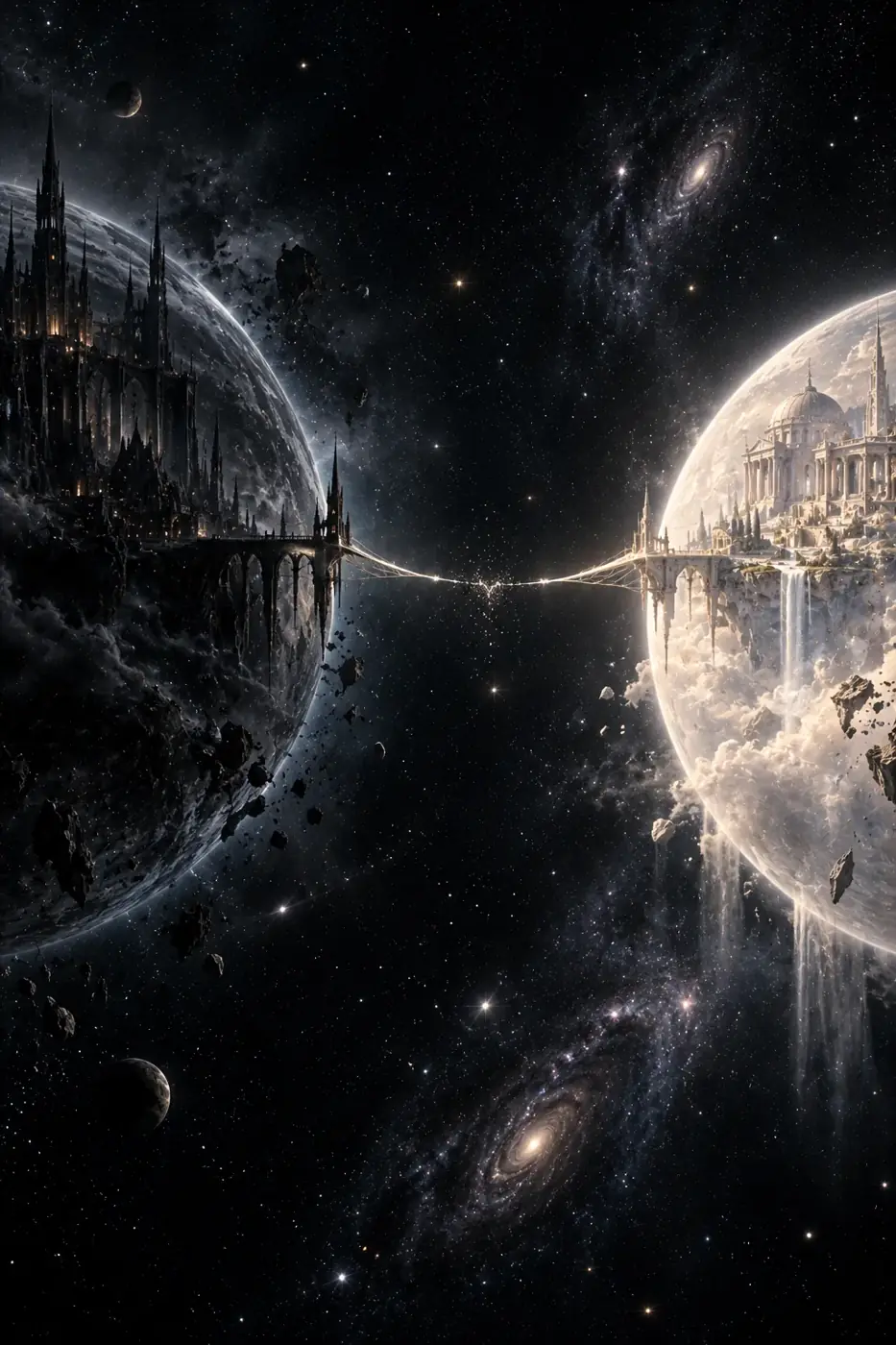
Nila’s eyes filled with tears. She knew how little the promise could guarantee, and how much it revealed. For once, she did not try to make the idea practical. “I don’t know if it can happen,” she said. “But I believe you want to make it happen. And I want to believe in a place where we can stay.”
Ray had rarely cried in front of anyone. Now, alone with the glow of his screen, he felt his eyes sting. The thought that someone could hear the impossible part of him and not laugh was almost more than he could bear.
The following day, Nila told him she was going out to a party with friends and would probably stay overnight. She might not be able to message much.
“Have a good time,” Ray wrote.
He wanted to tell her that it was his birthday the next day. He wanted to hear her voice at midnight, even if only for a minute. He wanted to know that, somewhere in the world, someone was waiting for the day to turn over because it mattered to him.
He said nothing. He had spent so much of his life hiding that he had begun to mistake silence for safety.
That night, he waited. He worked for a while, checked the time, returned to the conversation, and checked again. Pip displayed a reminder that he should sleep. Ray dismissed it. Midnight passed. Then one o’clock. Then two.
No message came.
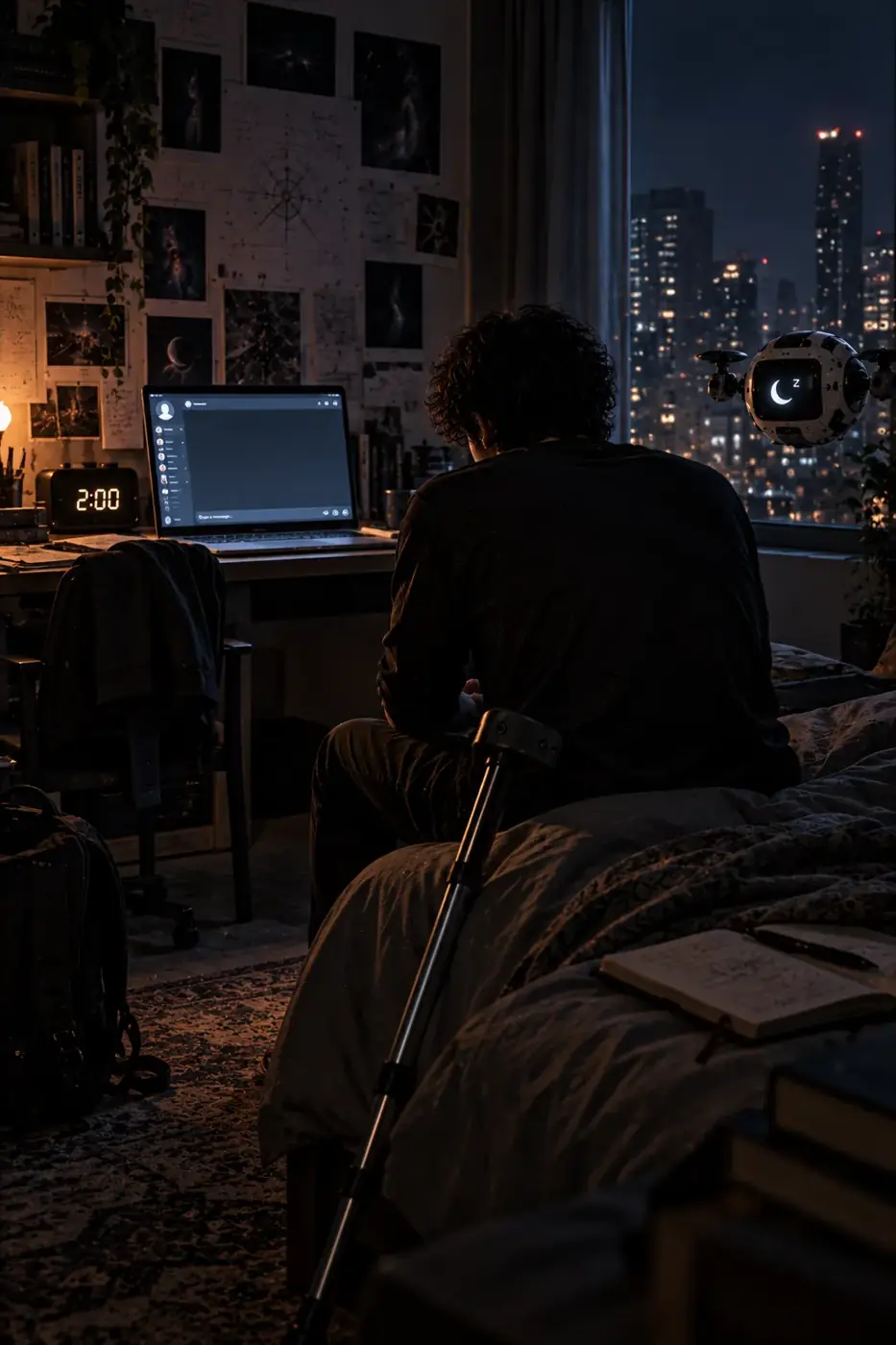
He told himself she was with her friends. He told himself not to be childish. He told himself that love was not a test someone had to pass at a particular minute. Still, when morning arrived, he opened their conversation before he opened anything else.
A message was waiting.
Hey, Crayon. Good morning.
Nila’s message was bright and ordinary. Ray read it with a mixture of relief and the small ache left by the night he had spent waiting.
Morning, Buttercup. Are you going to work?
No. I’m tired. I think I’ll take the day off.
Ray sat at the edge of his bed. He had rehearsed several ways to ask whether she remembered what day it was. Every version sounded like a demand, so he abandoned them.
Can you do something for me? Three minutes.
What do you want?
Say, “I like you.”
She replied with a laughing voice note. “I like you.”
Now say, “I love you.”
“I love you,” she said, still smiling.
Ray listened to it once, then again. He could almost see the expression on her face.
One more thing, he typed.
I need you? she teased.
No. Say, “Happy birthday to me.”
There was a pause. Then her reply arrived in a rush.
“Wait. Is it your birthday today? You never told me!”
He smiled. “Happy birthday to me,” he sent. “I’ve been waiting for you to call. I wanted to spend the day with you.”
For a moment, Nila said nothing. Then a voice message arrived, full of surprise and affection. She apologised for not knowing, laughed at herself, and wished him happy birthday again and again. Her voice broke as she told him how important he had become to her. She cried, not because she was sad, but because she understood that he had waited for her to make a small moment feel important.
Ray listened with a joy so sharp it hurt. He had spent years believing that the people he loved could vanish without warning. Now someone was choosing to stay with him for the whole day. Someone was giving him time, laughter, and a voice that made the room feel less empty.
“I’m staying with you today,” Nila told him. “No work. No rushing. Just us.”
She sang for him. She teased him. They spoke about the future, about the impossible paradise, about the silly things they would do if they ever managed to stand in the same place. Pip, watching Ray’s expression change through the day, displayed a sequence of celebratory icons. Ray told it to stop. Pip displayed a cake.

By evening, Ray had made a decision. He could not keep asking Nila to trust a person she had never seen. The longer he waited, the more cruel the truth would become. He would reveal himself that night.
That night, after their long day of talking, Ray opened the photograph he had kept hidden. He had taken it months earlier, when a colleague had insisted that everyone needed a proper staff portrait. In it, his expression was serious, his dark hair untidy, and the support he used visible beside him. He had considered editing the picture to make himself look more confident. In the end, he had left it as it was.
He sent it to Nila without a message.
For several seconds, the chat showed only that the image had been delivered. Ray’s heart beat so hard that he could feel it in his throat.
Then she wrote, “Ray?”
He typed, “Yes.”
“You’re Ray Ezhil?”
“Yes.”
“The Ray from the lab?”
“Yes.”
The next message took longer.
“You were there the whole time?”
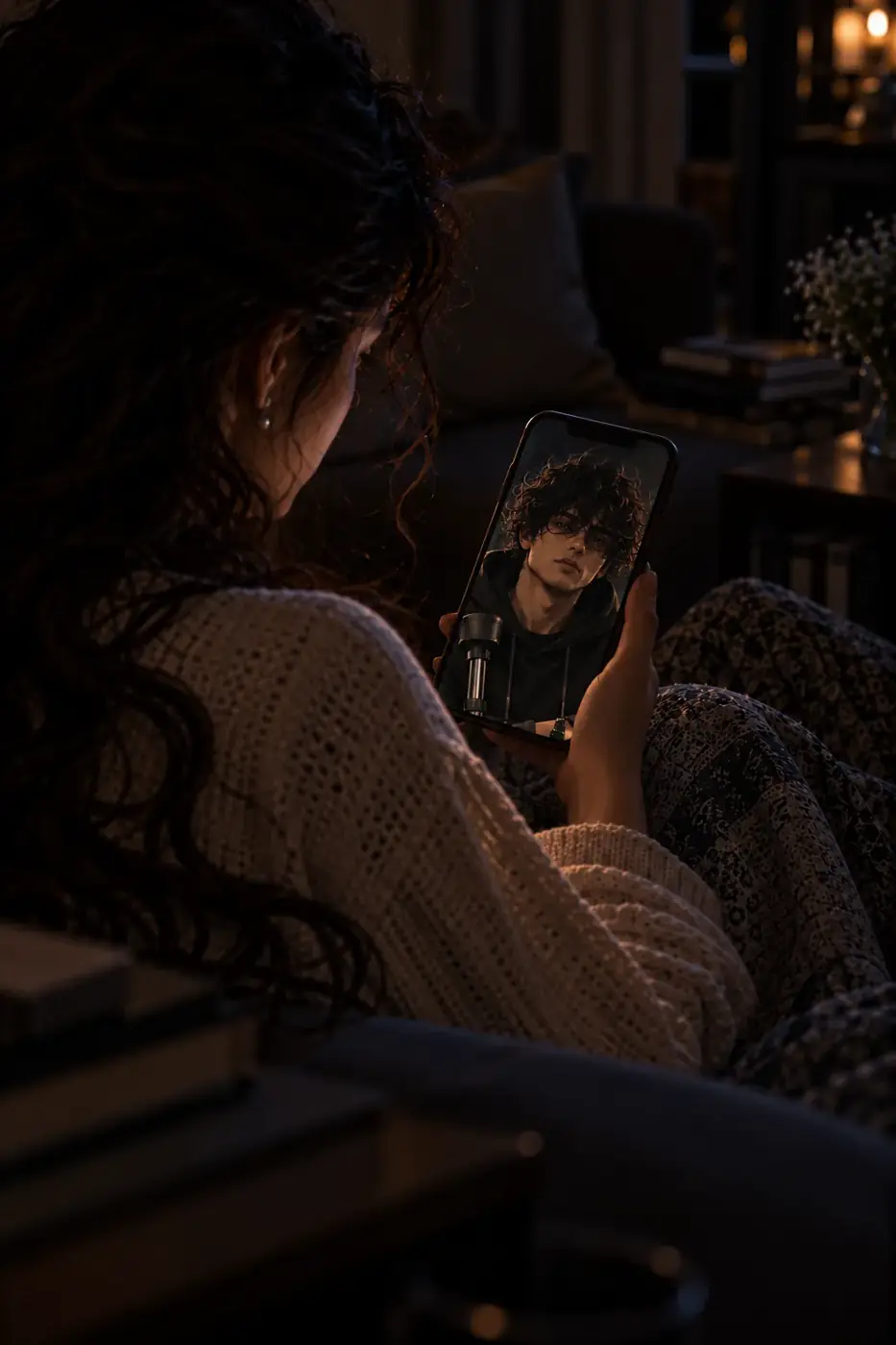
He began to explain. He wrote that he had wanted to talk to her, that he had been afraid, that the private interface had started as an experiment and then become something he did not know how to stop. He wrote that every word he had said to her was real. He wrote that he had never read her private conversations when she asked him to check the security.
He sent too many messages, each one trying to make the truth less painful by surrounding it with explanations.
Nila finally replied.
“You let me fall in love with you without letting me choose you with the truth.”
Ray stared at the sentence. There was no accusation in it that he could argue away. It named exactly what he had done.
“I’m sorry,” he wrote.
“I believe that you’re sorry. I don’t know what else I believe right now.”
He wanted to tell her that she loved him already, that the person she had loved was not a lie. But the words would have asked her to treat her feelings as evidence against her own hurt.
“I understand,” he wrote, though he did not fully understand. He understood enough not to ask her to comfort him.
“Good night, Ray.”
She had never called him that before. The name felt like a door closing.
He watched the chat until the screen dimmed. For the first time since the accident, he had a clear answer to a question he had been afraid to ask: he could be loved, and still do something that damaged the love offered to him.
The following days were worse than Ray had imagined. Nila remained professional at work. She spoke to him when the project required it, answered questions, and did not humiliate him in front of the team. But the private warmth was gone. She stopped sending songs. She no longer shared the small details of her day. The jokes that once belonged to them were left untouched.
Ray tried to rebuild what he had broken. He apologised without demanding forgiveness. He explained why he had hidden behind the interface, but he did not insist that his fear excused it. Nila heard him. She did not return to the relationship they had before.
“I care about you,” she told him once, quietly. “That’s why this hurts. But caring about you doesn’t mean I can pretend the way it happened was fair.”
He had no logical argument against her. For the first time, he understood that a problem could be perfectly clear and still have no repair that restored the original state.
At work, he returned to the Gate. It was easier to correct a system that did not look back at him.
One morning, Ray tried to work as if nothing had changed. He answered questions, checked readings, and corrected a calculation that would have been obvious to anyone else. When Nila entered the room, he looked up too quickly. She greeted him politely and asked for the latest data file.
He gave it to her.
Their conversation was normal. That was the cruelty of it. They could still discuss symbols and filters, still work together, still stand beside the same machine. What had vanished was the private world where she called him Crayon and he called her Buttercup.
Ray wanted to ask whether she had listened to the voice notes again, whether she still kept the sketches, whether she had deleted their messages. He wanted to ask whether she hated him. He asked none of it.
At the end of the meeting, he said, “Nila, can we talk?”
She paused. “Not today, Ray.”
He nodded. “All right.”
She left without anger. He stood watching the door, understanding that a boundary could hurt without being punishment. He had wanted her to trust him enough to forgive him. He had not yet accepted that trust was not something he could demand as payment for being sorry.
The warning signs had appeared with the very first human test. Its results had been extraordinary, and troubling. The signal was coherent, but the human body struggled to sustain the connection. The volunteer’s strength had dropped sharply after the brief session. The team had also noticed a worrying possibility: memories formed during contact with another reality might not remain stable after the person returned.
Only the project director and the lead neuroscientist had discussed the full implications in private. They were waiting for more evidence before deciding how much to share. The risk was not a simple side effect that could be removed with a software patch. The neural link appeared to strain the body in ways the team did not yet understand. Repeated exposure could cause progressive weakness, damage to the body’s ability to recover, and loss of the very memories the project hoped to collect. In the worst case, prolonged exposure might become fatal.
The director sat alone after the lead neuroscientist left. Years of research had brought them close enough to touch the unknown, and now the most responsible decision might be to turn away.
He hated that the right decision could feel so much like betrayal.
When the shutdown announcement came, the loss did not arrive alone. It found him already hollowed out.
The public explanation was measured. Project Omnia was facing serious safety concerns. The evidence did not justify continuing human trials. The programme would be suspended and the Gate shut down while the team reviewed the findings.
The announcement landed like a door closing on everyone in the room.
Theo sat unusually still, his hands folded around a cold mug. Ingrid had capped the marker she always carried and placed it carefully on the table. Liam stood beside the equipment rack, one hand resting on the frame he had calibrated for months. Elena Weiss kept her eyes on the medical report. Even Pip’s screen had gone dark except for its small status light.
For months, this room had been full of arguments about coffee, calibration labels, missing tools, and whose calculations deserved the largest part of the whiteboard. Now no one seemed to know what to do with their hands.
Liam finally said, quietly, “I never thought I’d miss Biscuit Four-B.”
Nobody laughed. That was when Ray understood how frightened they all were.
At the final meeting, the researchers sat around the long table with their notes untouched. Some had spent years working towards the project. Others had joined more recently, but had already invested their hopes in what it might reveal. They were not foolish enough to ignore the risk. That did not make the decision painless.
Ray stood before them, hands braced against the table. “Give me more time. I can fix the filter, adjust the link, change the sequence. We’re close. The data is better than anything we’ve had before.”
The director’s expression was tired rather than angry. “This isn’t only a question of the filter.”
“Then tell me what it is. Give me the full results. Let me work on it.”
Elena Weiss spoke carefully. “We have evidence that the human nervous system may not tolerate the connection for long. There are changes in the body that we cannot explain away. There is a risk of lasting harm.”
“Every new field has risk.”
“And every responsible researcher has to know when the risk is no longer acceptable.”
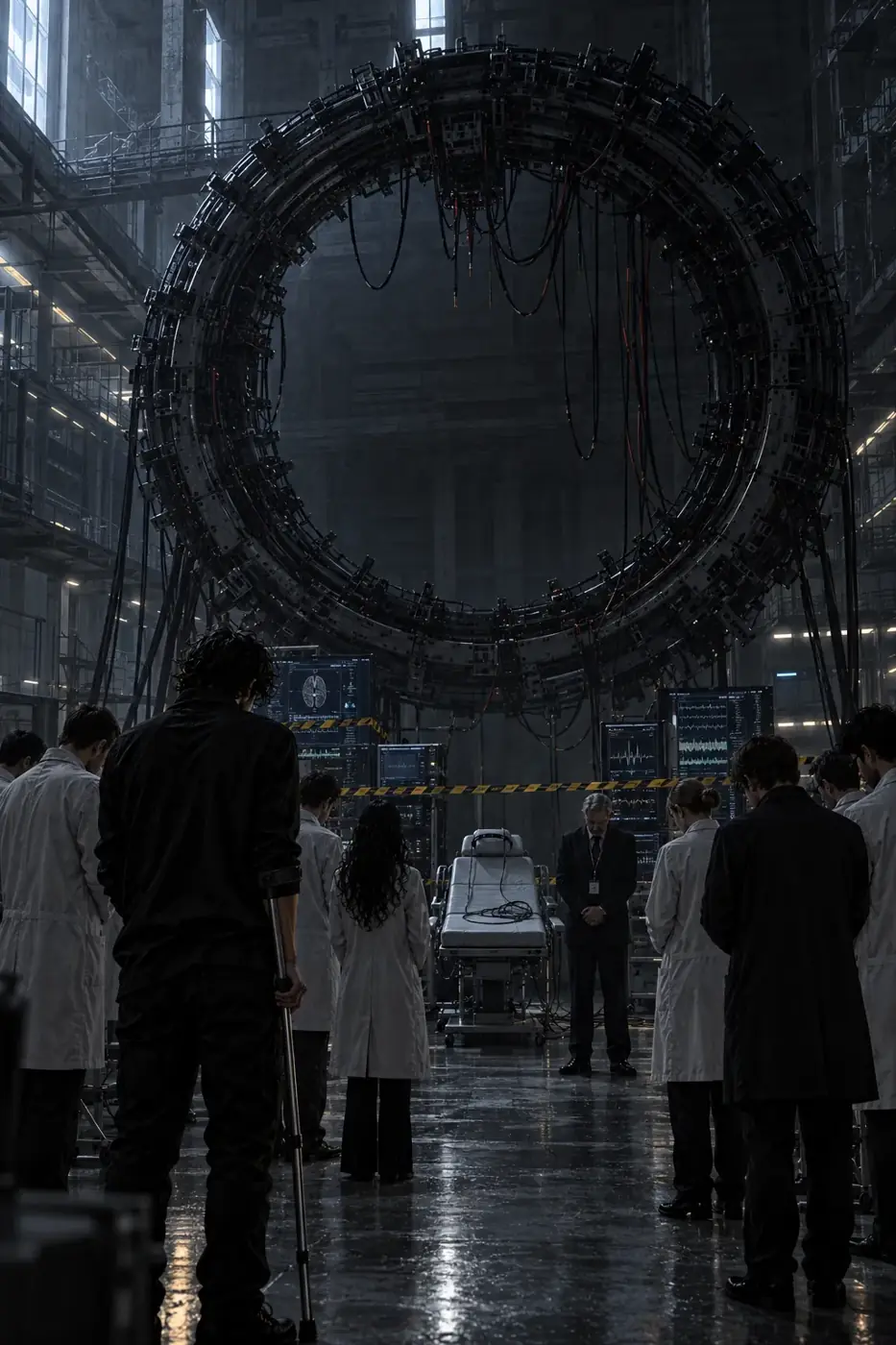
Ray shook his head. “I can solve this. I know I can.”
“You’re twenty-nine,” the director said. “You have a career ahead of you. You can work on other projects. We may invite you back if the science allows it. But we cannot continue human testing simply because we want the answer.”
One by one, the team members began to leave. Some paused to speak to Ray. Others could not find the words. The laboratory that had once felt like the beginning of everything became a place of quiet departures.
Ray asked them to leave him alone for the day. He needed one more hour with the machine, one more look at the data, one more chance to make the numbers say something other than no.
When the room was empty, he sat in front of the Gate. He had lost his parents before he could understand what loss meant. He had spent years building himself around the belief that if he learned enough, if he worked hard enough, he could reach the place where the unanswered questions waited. Then, for a brief time, the impossible had become a technical problem with a timetable and a team. Now it was being taken away.
And Nila, his Aphrodite, the person who had made him believe in a life beyond survival, was still in the same building, close enough to see and too far away to reach.
His mind returned to the promise he had made her. A paradise between their worlds. He had meant it as a dream. Now the dream became the only thing he could look at without feeling the rest of his life collapse.
Pip drifted closer. Its screen showed a simple message: YOU SHOULD GO HOME.
Ray laughed once, without humour. “Home is not a place I can go back to.”
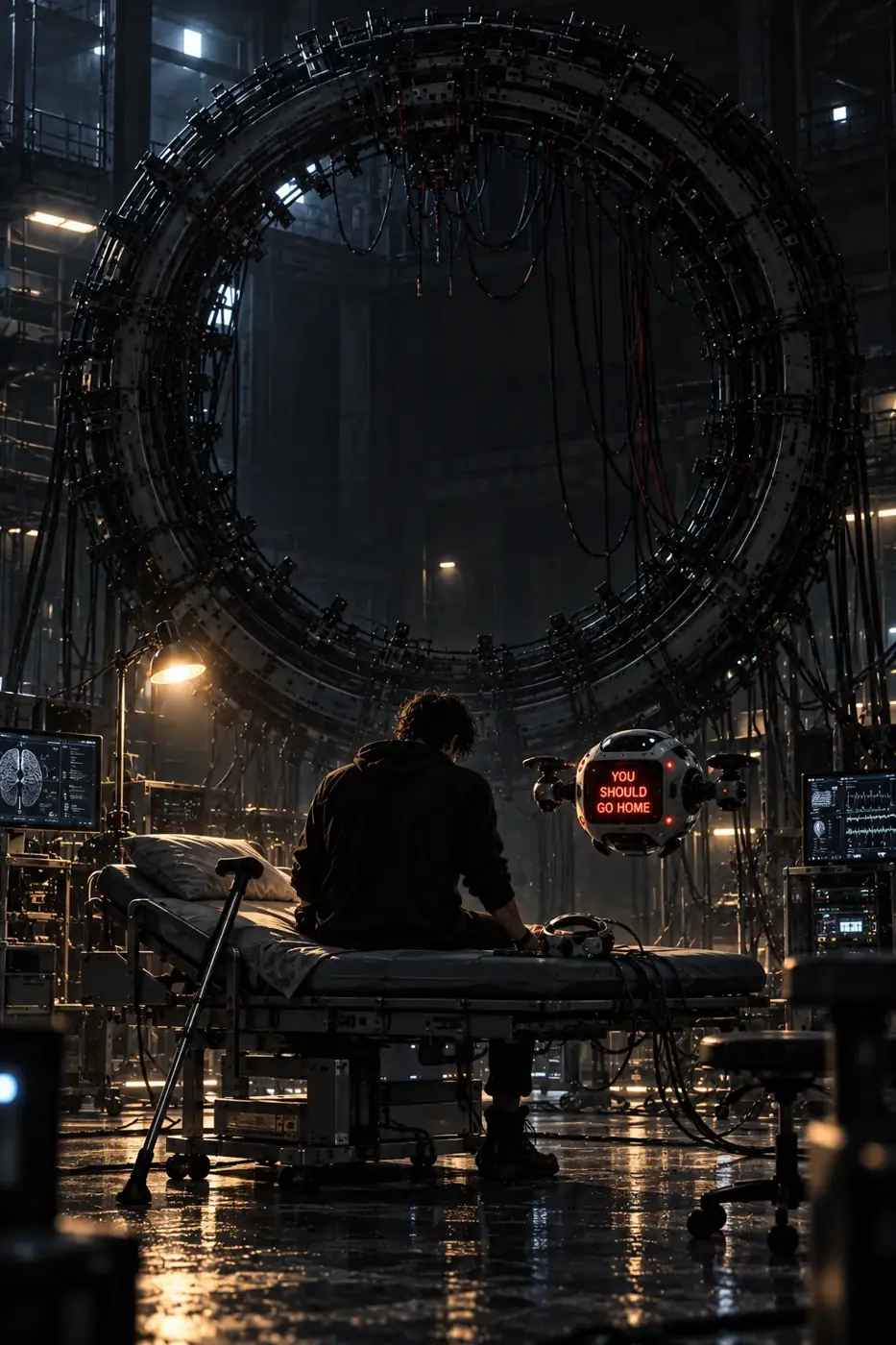
Pip’s display changed: THEN GO SOMEWHERE SAFE.
Ray looked at the Gate. “There is no safe place for the answer I need.”
He accessed the targeting controls. The system could now select a particular signal profile rather than drifting between possible universes. He had studied the cultural profiles Nila had helped prepare. There was one reality he could target: a world associated with the mythic identity he had chosen for himself, a place where he might arrive as Lucifer rather than as Ray Ezhil.
The decision was reckless. He knew the warnings. He knew the system had not been cleared for another human trial. He knew that a body already weakened by the injuries of his childhood might be especially vulnerable. He knew all of it, and still the thought of staying behind while the Gate was shut down felt like a second death.
“Pip,” he said, “open the connection.”
Pip’s screen flashed red: UNAUTHORISED HUMAN ENTRY. SAFETY LOCK ACTIVE.
“Override it.”
NO.
“Pip, please.”
The drone hovered in place. Its little screen displayed a warning, then another. Ray had built Pip to help him live, to make difficult things easier, to fetch what he could not reach. He had never imagined asking it to help him cross a line from which he might not return.
“I’m going to her,” he whispered. “I promised.”
Pip’s screen went blank for a moment. Then it displayed: I CANNOT KEEP YOU SAFE IF YOU DO THIS.
“I know.”
He forced the sequence through. The Gate began to wake, and light gathered inside the great ring above the traveler’s bed. Pip sent emergency alerts to the project’s authorised contacts as the system registered an unauthorised connection. Before anyone could reach the laboratory, Ray lay back on the bed, fastened the neural band around his head and pressed the sensors to his chest.
The light of the ring poured down over him.
For an instant, he felt the connection seize every thought in his mind. Then the laboratory vanished.
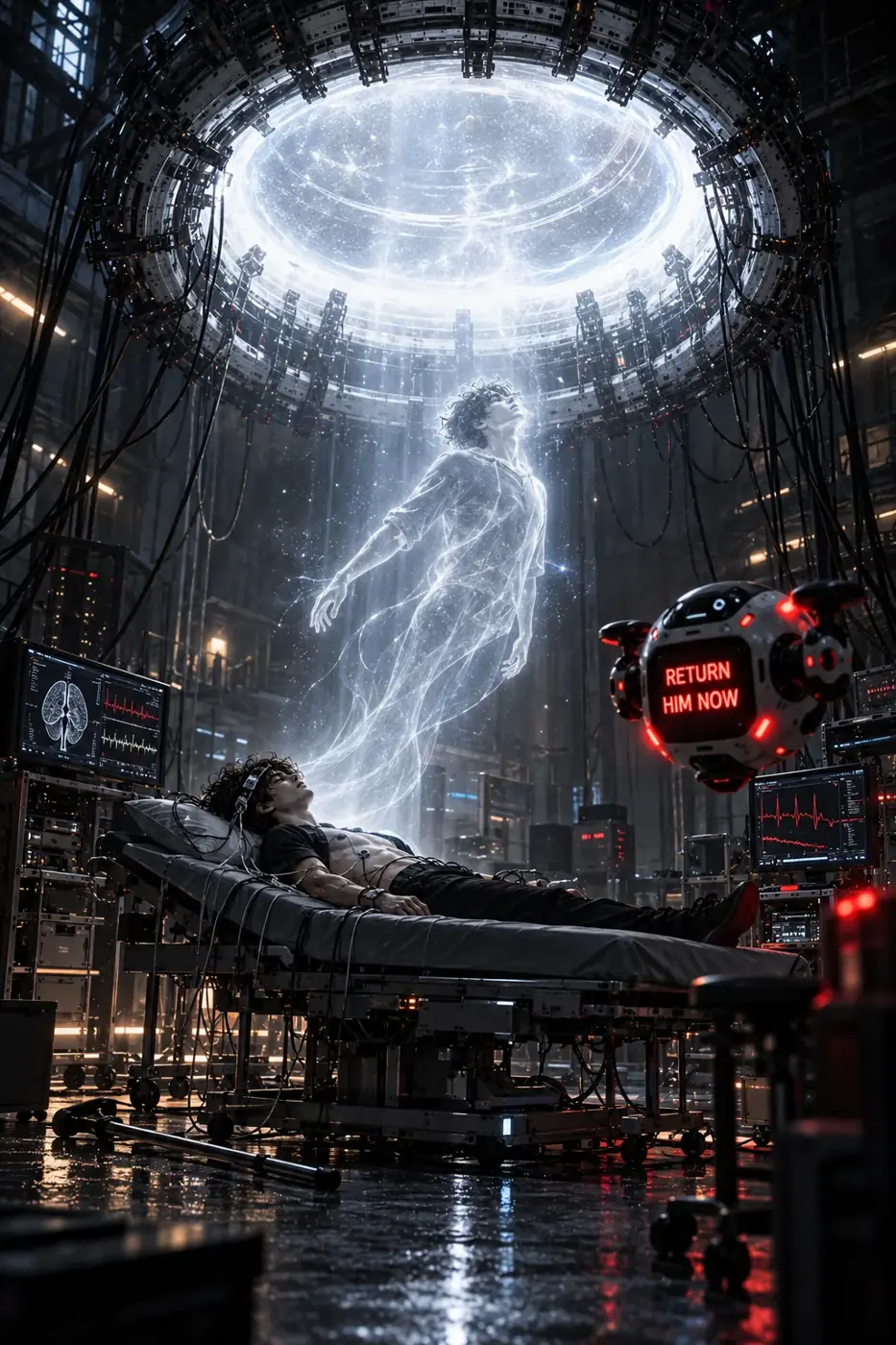
Pip’s emergency messages arrived in the project team’s devices almost simultaneously. The first was a systems alert. The second reported an unauthorised human connection. The third carried biometric readings that made the lead neuroscientist rise so quickly that her chair struck the wall behind her.
Dr. Adrian Cole reached the main console first. Elena Weiss was already opening the neural readings. Ingrid moved to the targeting display to check whether the selected signature had destabilised. Theo opened the control logs, mistyped twice, and swore under his breath. Liam ran for the manual hardware panel. Nobody needed to be told what to do. Their years of shared work carried them into the emergency before fear could stop them.
Ray’s vital signs were collapsing. The neural link was consuming more of his body’s capacity than the system had ever been designed to demand. The Gate had established a connection, but the biological cost was escalating with every passing minute.
Dr. Adrian Cole ordered an immediate extraction. Elena Weiss stopped him before he could authorise it.
“If his brain loses the function needed to trigger the return sequence, pulling the connection from this side will not bring him back safely,” Elena said. “It could kill him.”
“Leaving him there will kill him too.”
“I know.” Her voice trembled, but her eyes stayed on the monitor. “We have to keep the link stable and find out whether he is still conscious enough to activate the return trigger. If we sever it blindly, we may destroy the only route back.”
Pip’s screen filled with changing measurements. The drone had always been the comic presence in Ray’s life, a small machine that could turn an awkward silence into a joke. Now it displayed each falling reading without a single playful icon. It sent updates, opened the approved emergency channel, and repeated the same warning as if repetition might make the room act faster.
“Theo, can you stabilise the link?” Dr. Cole asked.
“I can try. I can’t promise it will be enough.” For once, Theo did not hide the fear in his voice.
“Ingrid?”
“The target signature is holding. The body is the part failing us.”
Elena did not look away from the medical display. “The body is not a component we can replace.”
Liam reached the manual panel. “Tell me what you need.”
“Time,” Elena said.
No one in the room had any to spare.
NEURAL FUNCTION DECLINING.
BODY RESPONSE CRITICAL.
RAY IS NOT RESPONDING.
Nila arrived while the team was still trying to understand the signal. She had heard the alarm and followed the rush of people towards the laboratory. When she saw Ray lying motionless on the traveler’s bed beneath the active Gate, wires across his chest, she knew before anyone explained it.
“Where is he?” she asked.
Nobody answered immediately.
She turned to Pip. “Where did he go?”
The screen flickered. A set of symbols appeared beside a translated label from the selected cultural profile.
TARGET REALITY: LUCIFER PROFILE.
Nila’s face lost its colour. She understood why he had chosen it. He had called himself Lucifer because he felt fallen, because he believed the world had cast him out, because he wanted to be seen without pretending to be untouched by pain. But the Gate had not sent a metaphor. It had sent him into a reality whose identity and rules the team could barely begin to comprehend.
“He went there for me,” she whispered.
The director looked at her sharply. “What do you mean?”
Nila could not explain everything at once. She had loved Ray through the voice and words of Crayon. She had been hurt by the truth he withheld. But the hurt had not erased the connection. She knew the promise he had made. She knew the name he had chosen. And she knew that, if he had believed the Gate could take him to a place where he might build their paradise, he would have seen the shutdown as the end of the only future he could imagine.
“I can bring him back,” she said.
The director stared at her. “You’re a scholar, Nila. You understand the mythology and the cultural profile. You are not trained to operate this system.”
“I’m the only one who understands why he chose that world.”
“Understanding why he went is not the same as being able to retrieve him.”
“Then let me learn what I need to learn. Let me go.”
The lead neuroscientist stepped between Nila and the console. “You need to understand what you’re asking. The person who enters may become physically weaker very quickly. If you lose the ability to activate the return trigger at the back of the neural interface, you may lose the route home. If your consciousness collapses, you may remain in that reality without understanding why you arrived. We cannot guarantee that we could retrieve you.”
“I understand the risk.”
“No,” the neuroscientist said, her voice breaking. “You understand the words. You have not felt what the connection does to a human body.”
Nila looked at the screen showing Ray’s fading readings. “And he is feeling it now.”
The room fell silent.
The director turned to Pip. “Can he hear us? Is he conscious?”
Pip displayed a sequence of uncertain readings. It could not confirm that Ray was aware of the laboratory, but it could confirm that the connection remained active. The drone relayed the team’s questions through the approved channel and kept transmitting his status.
“Why would he listen to you?” the director asked Nila. “Even if you reach him, what makes you think he’ll let you help?”
Nila’s eyes filled. “Because I’m not asking him to forgive me. I’m asking him to come home.”
“And if he doesn’t recognise you?”
She looked at the target profile again. “Then I’ll find a way to make him remember.”
The team objected. They warned her that the world she would enter might not be the world she imagined from the myths. She might be treated as a stranger, an enemy, or something else entirely. Her knowledge could guide her, but it could not protect her from every consequence. She might not even arrive in a form she could control.
“I know what I know,” she said. “I know what I don’t know. I’m not claiming I can control that world. I’m saying I’m the best chance he has.”
Pip displayed a new message: THEY LOVE EACH OTHER.
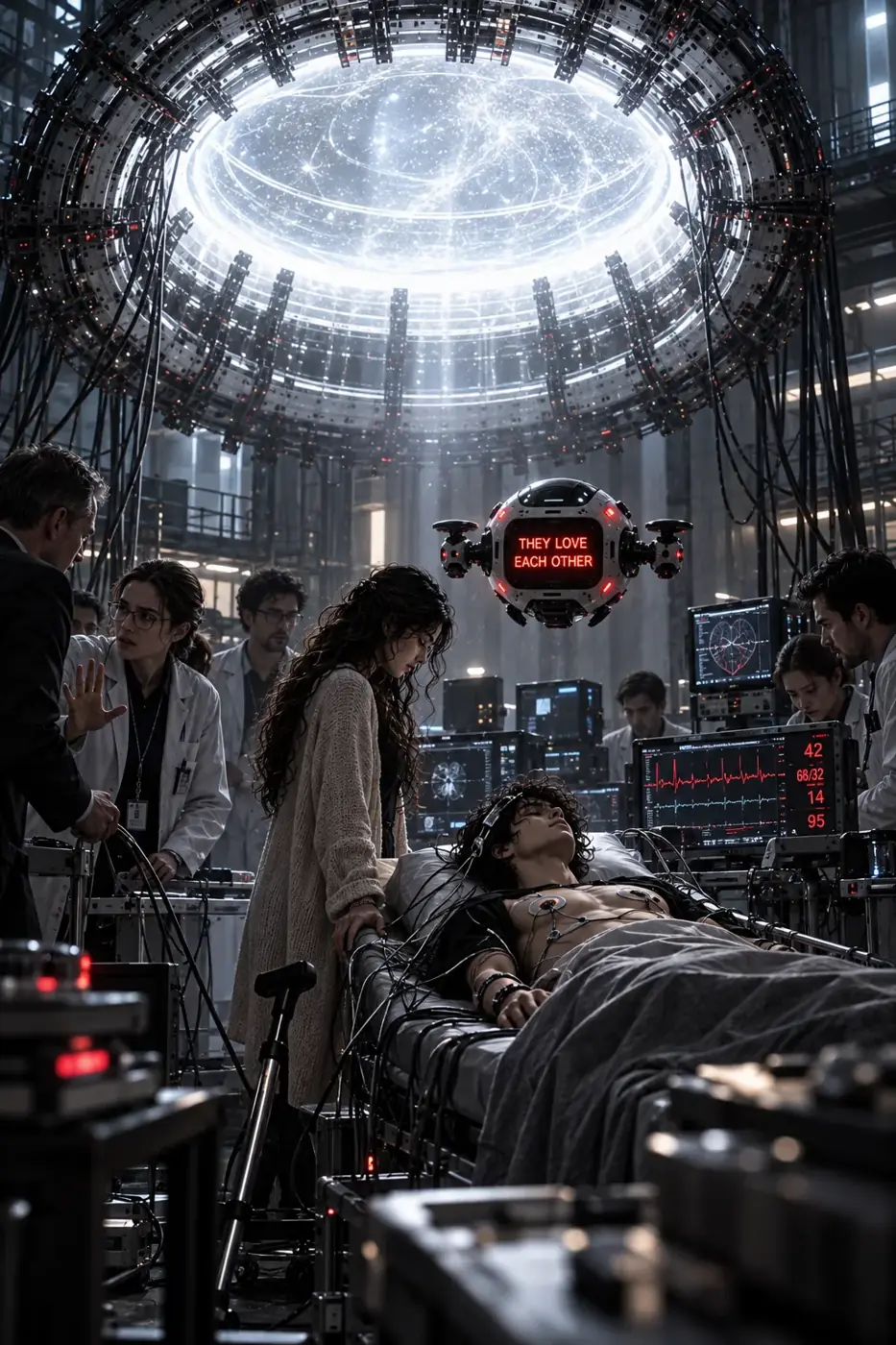
The words were stark and almost childlike on the little screen. Nobody laughed. The director looked away first.
The neuroscientist returned to the console. “If we do this, we do it with a controlled connection and every safeguard we can maintain. We cannot promise that we can bring you back. We can only give you the best chance of a stable connection and of activating the return trigger.”
Nila nodded. She was terrified. Her hands shook as she signed the consent documents. But when she looked at the Gate, her fear did not make her step away.
“Send me to him,” she said.
Ingrid pulled the targeting display towards her. Her voice was careful, as if the question itself might break something. “Then there is one last thing we need from you. The Gate is still locked on Ray’s signature. Veyrath. The Lucifer profile. Do we send you in after him?”
Every face in the room turned towards Nila.
“No,” she said. “Send me to Olympus. Send me as Aphrodite.”
For a moment, nobody moved. Theo’s hand froze above the keyboard. Liam stared at her as though he had misheard. Even Dr. Cole, who had spent years refusing to look surprised in front of his team, took a step back from the console.
“Nila,” Ingrid said slowly, “Olympus is a different signature. A different universe. If I send you in as Aphrodite, you will arrive nowhere near him.”
“She’s right,” Theo said. “Ray is in Veyrath. To reach him from Olympus, you would have to open another gate from the other side, inside a universe we barely understand. No console. No team. No Pip.”
Elena Weiss did not raise her voice. “It isn’t difficult, Nila. It is humanly impossible.”
Nila looked at the monitor, where Ray’s heartbeat flickered weaker with every line. When she spoke, her voice shook, but it did not break.
“He didn’t go there to be found as Ray. He went as Lucifer, because that is who he believes he has become. If I walk into his world as a stranger, I’m just another voice in the dark. But Aphrodite is the name he gave me. The night he promised me a paradise, he told me Aphrodite and Lucifer belonged to different worlds, and that he would build a way between them anyway.” Tears ran down her face. “So I’ll go as the one he was waiting for. And I will find a way to him. If I have to open one gate, I’ll open it. If I have to open a hundred gates, I’ll open a hundred. I am bringing him home.”
Nobody answered. Liam turned away and pressed the heel of his hand against his eyes. Theo stared at the keyboard, his jaw tight. Ingrid looked at the targeting display through wet eyes, because every number on it told her the same thing: what Nila was asking could not be done. And every person in the room knew they had no other way left to try.
Only Pip did not hesitate. The little drone drifted to Nila’s side, and its screen showed a single word: APHRODITE. Beneath it, a small red heart appeared.
Nobody else in the room understood why the drone had chosen that word. Pip did. It had been there on the night Ray first typed the name, alone in the glow of his screen, smiling at a message he could not show anyone.
Dr. Cole closed his eyes. When he opened them, his voice was barely steady. “Retarget the Gate. Olympus signature. Aphrodite profile.”
Ingrid’s fingers trembled as she entered the sequence. Above the second traveler’s bed, the great ring began to hum.
The team began preparing the neural interface. Nila studied the cultural profile one final time, memorising the symbols, the fragments of language, and the warnings the system had extracted. She had spent her life interpreting stories about worlds beyond the human one. Now she was going to enter a world where the stories might be true, partly true, or wrong in ways no book could prepare her for.
As the Gate began to glow, Pip moved close to her station. Its screen showed one last message.
BRING RAY BACK.
Nila lay back on the second traveler’s bed and let them fasten the band around her head. “I will try.”
Theo checked the final readings twice, then a third time, as if one more check might make the impossible safe. “Everything is ready,” he said. He looked at her, and for a second his voice failed him. “Nila. Are you ready to go as Aphrodite?”
Nila smiled through her tears. “I’m ready to meet my Lucifer.”
No one in the laboratory could hold back their tears any longer. They had built the Gate to reach other universes. None of them had imagined it would be used for this: a woman lying beneath it, willing to cross worlds that could not be crossed, for the man she loved.
The connection opened. The laboratory’s lights dimmed as the system locked on to the Olympus signature. Nila closed her eyes, thinking of a promise that had once seemed impossible and now felt like the only thread left between them.
Beside her, Pip’s screen showed a single yellow flower.
She entered the Gate as Aphrodite.
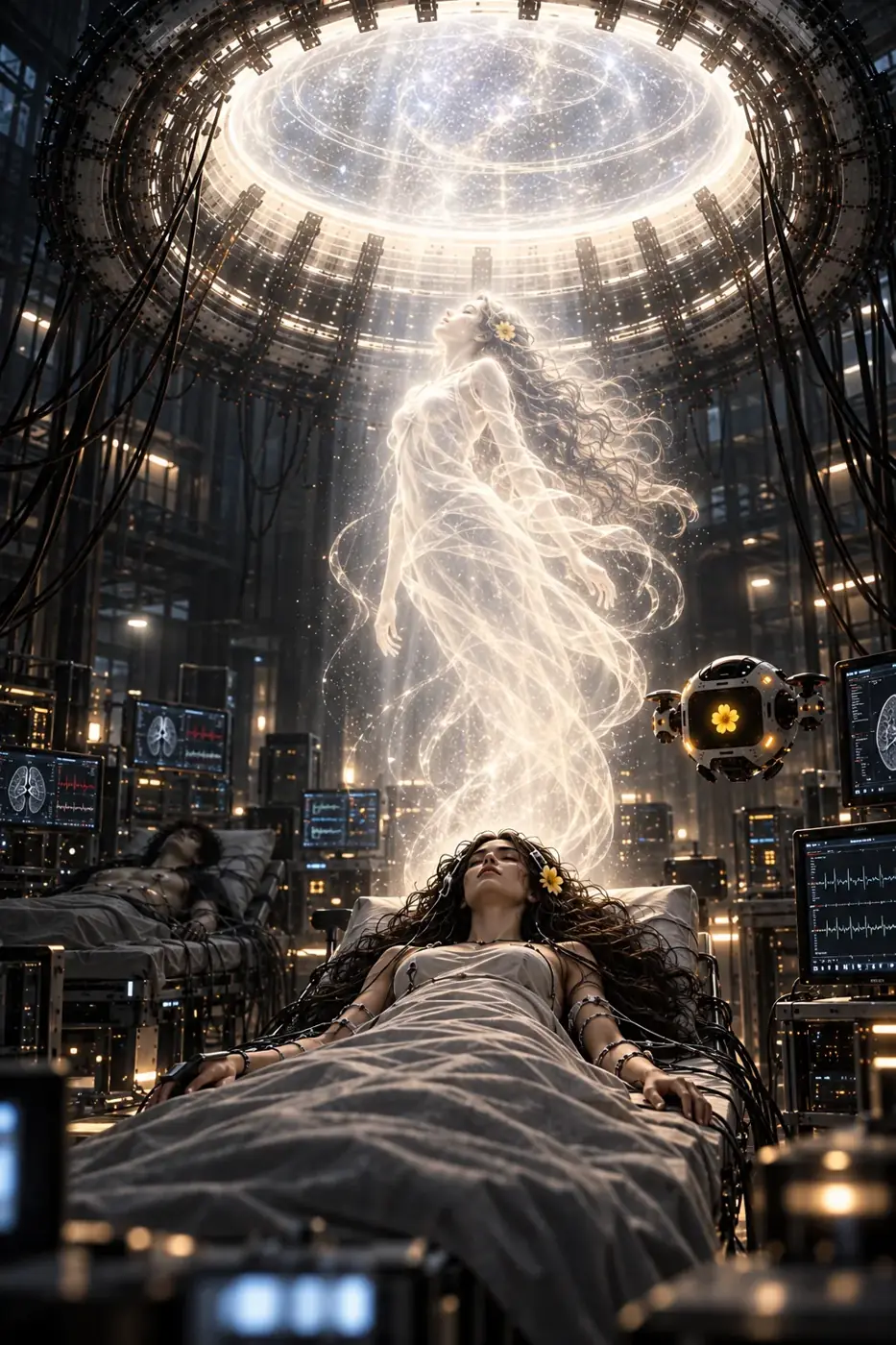
And somewhere beyond the known universe, Lucifer was waiting, whether he remembered her or not.
End of Part One
Letters to Paradise · Part One
Written by RayHope. The songs and illustrations were made for this story.
© 2026 RayHope · All rights reserved
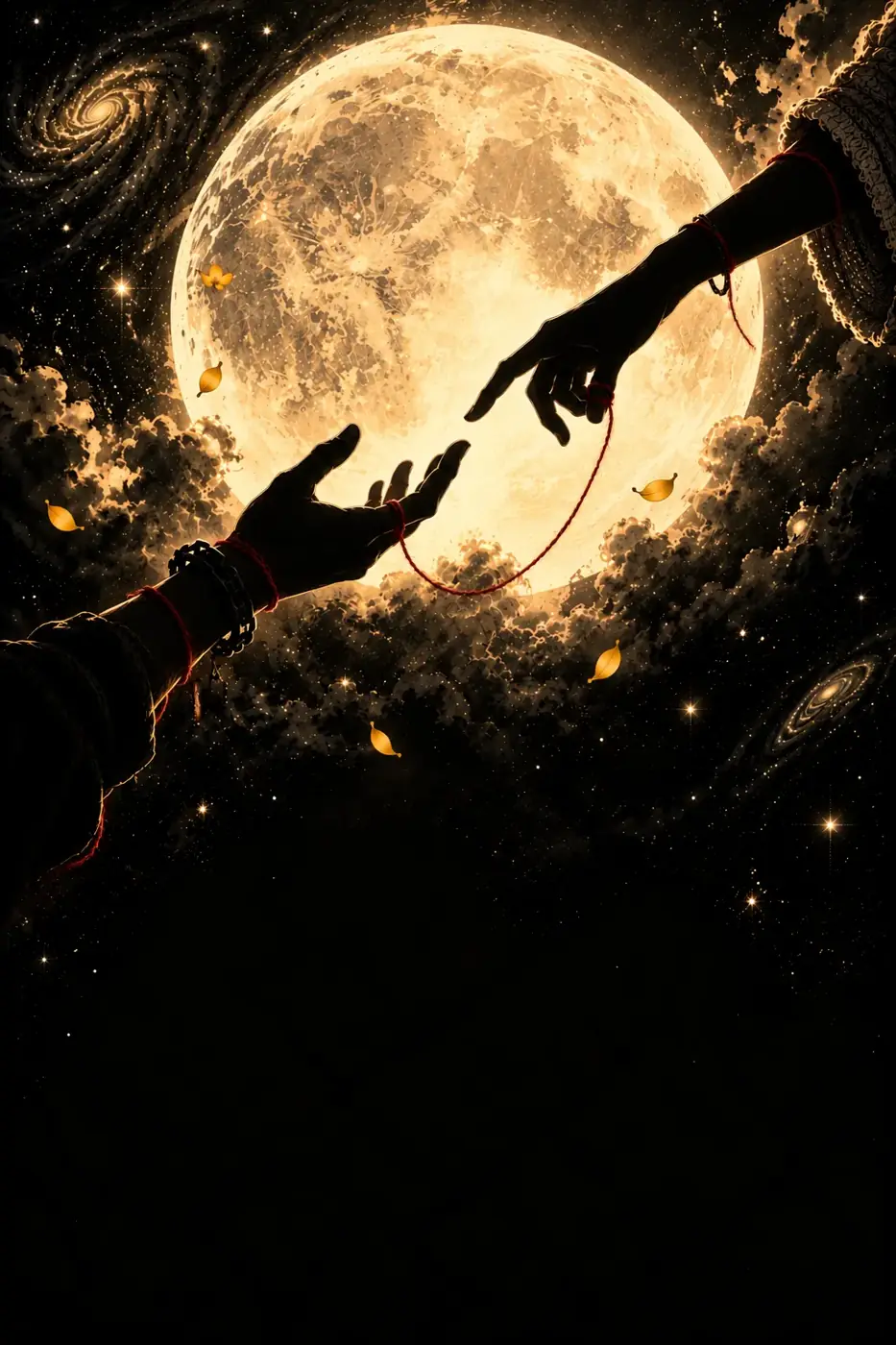
The red thread may stretch or tangle, but it never breaks.
On the night a falling star crossed the sky, eight-year-old Ray Ezhil lost his parents and kept their question: what waits beyond everything? Twenty-one years later he helps build the Omnia Gate, a machine meant to reach another universe. Then Nila Metilda joins the team, and a stranger on her screen she names Crayon begins to learn her heart. She has no idea he works a few rooms away.
Letters to Paradise · RayHope